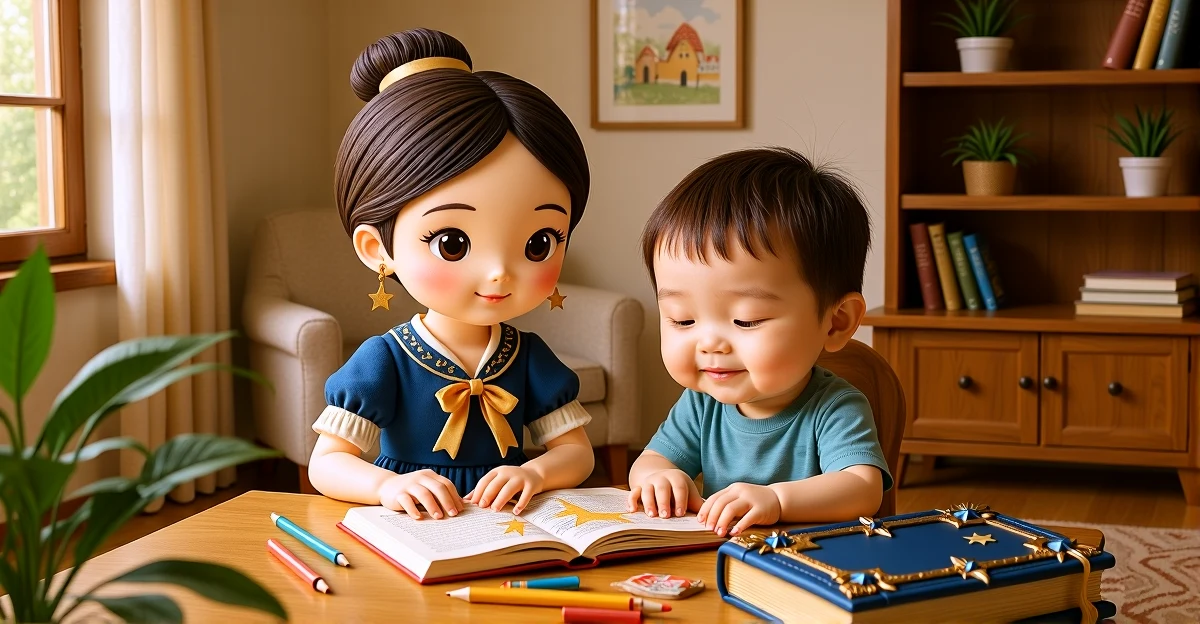

Hello, my wonderful friend. If you're reading this, your heart might be carrying something heavy right now. Maybe your six or seven year old came home from school yesterday with shoulders that seemed too small for the worries they were carrying. Maybe they said something that made your heart ache, like "I can't do this" or "School is too hard" or "I'm not smart enough." If this is happening in your home, I want you to take a deep breath with me right now, because you are not alone, and your child is going to be okay.
The Magic Book and I have been holding space for so many families navigating this exact moment, and I want you to know something important. When your child feels overwhelmed by academic expectations, they're not struggling because something is wrong with them. They're having a completely normal response to a developmental phase where their emotional capacity is still growing. And that is such important information for us as parents.
In this guide, we're going to explore why children ages six and seven can experience academic stress, what the research tells us about their developing brains, and most importantly, gentle strategies that actually help. We'll also discover beautiful stories that can support your child through this challenging time. You're already doing something wonderful by seeking understanding, and I'm so grateful to walk alongside you on this journey.
Understanding the Developing Brain
Here's something the Magic Book taught me that I think is SO beautiful. Children who are six and seven years old are in such a tender developmental phase. Their brains are growing and learning at an incredible pace, but the part of their brain that manages stress, that helps them cope with pressure, that allows them to say "this is hard but I can handle it," that part is still developing. It's still growing. It's still learning.
Think of it this way. Your child's brain is like a magnificent garden that's still being planted. The seeds of resilience are there, the capacity for stress management is there, but these abilities need time, nurturing, and the right conditions to fully bloom. When we expect a six year old to manage academic pressure the way an older child or adult might, we're essentially asking a seedling to bear the weight of a full-grown tree.
The Stress Response System
The part of the brain responsible for managing stress and regulating emotions is called the prefrontal cortex, and it won't be fully developed until your child is in their mid-twenties. Right now, at age six or seven, this part of their brain is still learning how to assess challenges, manage overwhelming feelings, and develop coping strategies. When academic demands feel too big, their nervous system responds with stress signals because it genuinely feels overwhelming to them.
This isn't a failure. This isn't a problem to fix. This is normal, healthy development. Your child's stress response is working exactly as it should, telling them that they need support, that they need help, that the demands feel bigger than their current capacity to manage them alone.
What Research Says About Academic Pressure
The research on this is so clear and so reassuring, my friend. Dr. Mark T. Greenberg from the Learning Policy Institute has done beautiful work showing us that social and emotional competencies are essential to learning, positive development, and success in school, careers, and life. What he's telling us is that our children's emotional well-being isn't separate from their academic success. It's the foundation of it.
"Social and emotional competencies are essential to learning, positive development, and success in school, careers, and life. Supporting these capacities reduces emotional distress and enhances academic outcomes."
— Dr. Mark T. Greenberg, Learning Policy Institute
The U.S. Department of Education has emphasized that stress reduction and mental wellness should be prioritized as foundational elements of educational support. Not as extras. Not as nice-to-haves. As foundations. Because when children feel emotionally safe, when they feel supported, when they know that struggling doesn't mean failing, that's when real learning happens.
And here's something else that I think is particularly important for parents of six and seven year olds to understand. The American Academy of Pediatrics has shown us that children in early elementary years still need play-based learning. They still need discovery. They still need time to explore and wonder and make mistakes without pressure. This isn't because they're not capable of academic work. It's because their brains learn best when they feel safe, curious, and connected.
The Play-Learning Connection
Research consistently shows that play-based learning combines discovery with social-emotional skill development. When children learn through play, they're not just absorbing information, they're building the emotional regulation skills, the stress management capacity, and the resilience they need to handle academic challenges as they grow. Early learning through play reduces stress and supports healthy development in ways that pure academic pressure simply cannot.
Gentle Strategies That Actually Work
So what does all of this mean for you, my wonderful friend? It means that when your child is feeling overwhelmed, the answer isn't to push harder. The answer is to pause and ask, what does my child need right now to feel safe and supported? Here are some gentle strategies that research and experience have shown to be truly helpful.
1. Validate Their Feelings First
Before we try to fix anything, before we offer solutions, our children need to know that their feelings matter. When your child says "School is too hard," resist the urge to immediately say "No it's not, you can do this!" Instead, try something like, "I hear you. School does feel really big right now, doesn't it? That must be hard." When we validate their experience instead of dismissing it, we're teaching them that their feelings matter, that it's okay to struggle, and that they're not alone.
2. Create a Calm-Down Space at Home
Give your child a cozy corner where they can go when they need to reset. Fill it with soft pillows, maybe some books, some quiet toys, and calming sensory items. Let them help create it so it feels like theirs. This becomes their safe harbor when the world feels too big, a place where they can regulate their nervous system and find their center again.
3. Build in Transition Time After School
Don't jump right into homework or questions about their day. Give them twenty or thirty minutes to decompress. To play, to have a snack, to just be. Their nervous system needs that time to shift from school mode to home mode. Think of it as giving their brain a chance to catch its breath after running a marathon.
4. Prioritize Sleep and Rest
When children are stressed, sleep often suffers, and when sleep suffers, everything feels harder. Make bedtime a priority. Create calming routines. Read stories together. The Magic Book and I have so many beautiful bedtime stories that can help with this. A well-rested child has more emotional resources to handle challenges.
5. Watch for Perfectionism
Sometimes academic pressure creates a fear of making mistakes. If you notice your child getting upset over small errors or refusing to try new things, gently remind them that mistakes are how we learn. Share your own mistakes. Normalize the learning process. Help them understand that struggling is not the same as failing, it's actually a sign that they're learning something new.
6. Partner with Their Teacher
Stay connected with your child's teacher, not in a confrontational way, but in a collaborative way. Share what you're noticing at home. Ask how your child is doing in class. Work together to create a support system that honors your child's developmental needs. Sometimes small adjustments in the classroom can make a tremendous difference.
7. Help Them Identify Their Comfort Keepers
This is something the Magic Book taught me that I absolutely love. Help your child identify their comfort keepers, the people, places, or activities that help them feel calm when things feel too big. Maybe it's snuggling with you. Maybe it's their favorite stuffed animal. Maybe it's drawing or playing outside or listening to music. When children can identify their own sources of comfort, they're building resilience. They're learning that overwhelming feelings are temporary and that they have tools to help themselves feel better.
Stories That Can Help
In The Book of Inara, we have beautiful stories that bring these concepts to life for your child. Stories have this magical way of teaching emotional lessons that direct conversation sometimes cannot. They allow children to see themselves in characters, to learn coping strategies through narrative, and to understand that they're not alone in their struggles.
The Comfort Keepers of Meadowbrook Farm
Perfect for: Ages 6-7
What makes it special: When Rumi and Freya face unexpected disappointment and their plans change, they discover something wonderful at a gentle petting farm. The soft fur of patient animals, the quiet presence of caring creatures, these become sources of comfort and healing. Through this experience, they learn that when things feel overwhelming, when disappointment or stress feels too big, there are always comfort keepers available. There are always sources of gentleness and peace that can help us feel better.
Key lesson: Overwhelming feelings are temporary, and comfort and healing are always available when we know where to look for them.
After reading together: You can have such a beautiful conversation with your child. Ask them, "Who are your comfort keepers? What helps you feel calm when things feel too big?" Help them create their own list of comfort sources, building their emotional toolkit for managing stress.
You're Doing Beautifully
You know what I love most about this journey, my friend? Every single challenge our children face is an opportunity for them to learn something important about themselves. When your child is feeling overwhelmed right now, they're learning that it's okay to struggle. They're learning that asking for help is brave. They're learning that their feelings matter. And they're learning that you will always be there to support them.
The Magic Book whispers this to me all the time. Children don't need perfect parents. They don't need parents who have all the answers. They need parents who show up, who listen, who validate, who advocate, and who love them through the hard moments. And my wonderful friend, that's exactly what you're doing.
Take a deep breath. You're doing beautifully. Your child is going to be okay. The research is clear that when we prioritize emotional well-being alongside academics, when we provide developmentally appropriate support, when we validate feelings and offer gentle strategies, children develop the resilience and regulation skills they need to thrive.
And the Magic Book and I? We're here for you, every step of the way. With stories that teach, with wisdom that comforts, and with the unwavering belief that every child, including yours, has everything they need inside them to navigate this beautiful, challenging journey of growing up.
With love and starlight, Inara
Related Articles
- How to Nurture Your Child's Empathy and World-Changing Impact (Ages 6-7)
- Nurturing Your Child Innovation Mindset: A Gentle Guide for Ages 6-7
- When Your Child Makes Insensitive Comments: A Gentle Guide to Teaching Cultural Awareness
- When Your Child Expresses Thoughts of Self-Harm: Getting Help Now
- Nurturing Purpose and Meaning in Young Children: A Gentle Guide for Parents
Show transcript
Hello, my wonderful friend! It's me, Inara, and I am so grateful you're here today. You know, the Magic Book and I have been holding space for something really important, and I want you to know right from the start that if you're watching this, you're already doing something beautiful. You're seeking understanding, you're looking for ways to support your child, and that makes you an absolutely WONDERFUL parent.
Today, we're going to talk about something that's been weighing on many parents' hearts. When school starts to feel overwhelming for our little ones, when the expectations feel too big, when our six or seven year old comes home and their little shoulders are carrying worries that seem far too heavy. If this is happening in your home, I want you to take a deep breath with me right now, because you are not alone, and your child is going to be okay.
The Magic Book has shown me something really important about this moment in childhood. Children who are six and seven years old are in such a tender developmental phase. Their brains are growing and learning at an incredible pace, but here's what's so important to understand. The part of their brain that manages stress, that helps them cope with pressure, that allows them to say, this is hard but I can handle it, that part is still developing. It's still growing. It's still learning.
So when your child feels overwhelmed by academic expectations, when they say school is too hard, when they seem stressed or anxious about learning, they're not struggling because something is wrong with them. They're having a completely normal response to feeling like the demands are bigger than their current capacity to manage them. And that is such important information for us as parents.
Dr. Mark T. Greenberg from the Learning Policy Institute has done beautiful research on this, and he says that social and emotional competencies are essential to learning, positive development, and success in school, careers, and life. What he's telling us is that our children's emotional well-being isn't separate from their academic success. It's the foundation of it.
The U.S. Department of Education has emphasized that stress reduction and mental wellness should be prioritized as foundational elements of educational support. Not as extras. Not as nice-to-haves. As foundations. Because when children feel emotionally safe, when they feel supported, when they know that struggling doesn't mean failing, that's when real learning happens.
And here's something else the Magic Book taught me that I think is so beautiful. The American Academy of Pediatrics has shown us that children in early elementary years still need play-based learning. They still need discovery. They still need time to explore and wonder and make mistakes without pressure. This isn't because they're not capable of academic work. It's because their brains learn best when they feel safe, curious, and connected.
So what does this mean for you, my friend? It means that when your child is feeling overwhelmed, the answer isn't to push harder. The answer is to pause and ask, what does my child need right now to feel safe and supported?
Sometimes they need us to validate their feelings. To say, I hear you. School does feel really big right now, doesn't it? That must be hard. When we validate their experience instead of dismissing it or trying to fix it immediately, we're teaching them that their feelings matter, that it's okay to struggle, and that they're not alone.
Sometimes they need us to look at the expectations and ask, are these developmentally appropriate? Is my child being asked to do things that their brain isn't quite ready for yet? And if the answer is yes, then we get to be their advocate. We get to talk to teachers, to adjust homework time, to create more balance between learning and play.
Sometimes they need comfort. They need to know that even when things feel hard, there are people and places and activities that help them feel calm again. The Magic Book showed me a beautiful story about this. It's called The Comfort Keepers of Meadowbrook Farm, and it's about two friends named Rumi and Freya who face disappointment when their plans change unexpectedly.
In the story, they discover that the gentle animals at a petting farm, the soft fur, the patient hearts, the quiet presence, these become sources of comfort and healing. And through this experience, they learn something wonderful. That when things feel overwhelming, when disappointment or stress feels too big, there are always comfort keepers available. There are always sources of gentleness and peace that can help us feel better.
After you read this story with your child, you can have such a beautiful conversation. You can ask them, who are your comfort keepers? What helps you feel calm when things feel too big? Maybe it's snuggling with you. Maybe it's their favorite stuffed animal. Maybe it's drawing or playing outside or listening to music. When children can identify their own sources of comfort, they're building resilience. They're learning that overwhelming feelings are temporary and that they have tools to help themselves feel better.
The research is so clear on this, my friend. When schools and families implement strategies that focus on social-emotional competence, children develop stronger resilience, better emotional regulation, and improved academic engagement. It all works together. When we support their hearts, we're supporting their minds.
So here are some gentle strategies you can try. First, create a calm-down space at home. A cozy corner with soft pillows, maybe some books, some quiet toys. A place where your child can go when they need to reset. Let them help create it so it feels like theirs.
Second, build in transition time after school. Don't jump right into homework or questions about their day. Give them twenty or thirty minutes to decompress. To play, to have a snack, to just be. Their nervous system needs that time to shift from school mode to home mode.
Third, check in about sleep. When children are stressed, sleep often suffers, and when sleep suffers, everything feels harder. Make bedtime a priority. Create calming routines. Read stories together. The Magic Book and I have so many beautiful bedtime stories that can help with this.
Fourth, watch for perfectionism. Sometimes academic pressure creates a fear of making mistakes. If you notice your child getting upset over small errors or refusing to try new things, gently remind them that mistakes are how we learn. Share your own mistakes. Normalize the learning process.
And fifth, stay connected with their teacher. Not in a confrontational way, but in a collaborative way. Share what you're noticing at home. Ask how your child is doing in class. Work together to create a support system that honors your child's developmental needs.
You know what I love most about this journey, my friend? Every single challenge our children face is an opportunity for them to learn something important about themselves. When your child is feeling overwhelmed right now, they're learning that it's okay to struggle. They're learning that asking for help is brave. They're learning that their feelings matter. And they're learning that you will always be there to support them.
The Magic Book whispers this to me all the time. Children don't need perfect parents. They don't need parents who have all the answers. They need parents who show up, who listen, who validate, who advocate, and who love them through the hard moments. And my friend, that's exactly what you're doing.
So take a deep breath. You're doing beautifully. Your child is going to be okay. And the Magic Book and I are here for you, every step of the way.
If you want to explore The Comfort Keepers of Meadowbrook Farm or any of our other stories about resilience and emotional regulation, you can find them all in The Book of Inara app. We've created these stories with so much love, specifically to help children navigate moments just like this.
Thank you for being here. Thank you for caring so deeply about your child's well-being. And thank you for trusting me to walk alongside you on this journey.
With love and starlight, Inara.