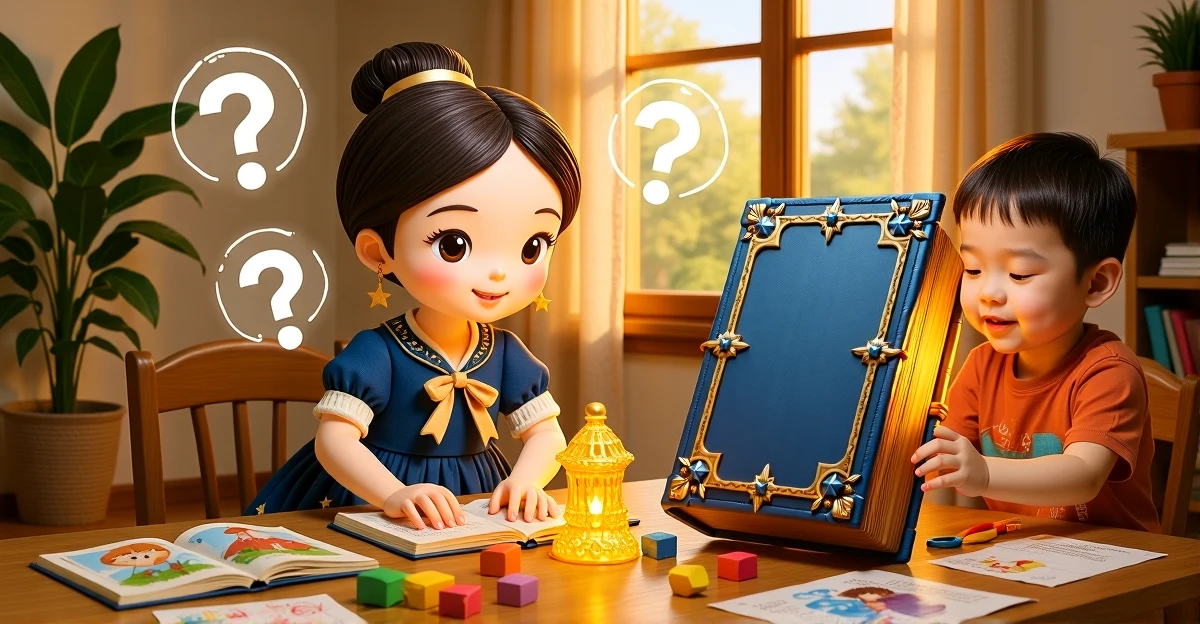

It's 7:30 in the morning. You're trying to get breakfast on the table, pack lunches, and find matching socks. And then it starts.
"Why is the sky blue?"
You give a quick answer while pouring cereal. But before you can even finish, here comes the next one.
"Why do birds fly?" "Why can't I see the wind?" "Why does water make things wet?"
The questions don't stop. They cascade, one after another, each answer spawning three more questions. And somewhere between "why do we have bones" and "why does the moon follow us," you might find yourself thinking: Is this ever going to end?
Here's what I want you to know, wonderful parent. Those endless why questions? They're not a test of your patience. They're not your child being difficult. What you're witnessing is something absolutely BEAUTIFUL. You're watching a scientist at work.
In this post, I'm going to share research-backed insights about why your kindergarten-age child's curiosity is so precious, how it's literally shaping their brain for future learning, and practical ways you can nurture this natural scientific thinking without needing a science degree or fancy equipment.
The Science Behind Your Child's Curiosity
Let's start with what's actually happening in your child's brain during those kindergarten years.
Research from Harvard's Center on the Developing Child shows us something remarkable: ages five and six represent a critical window in brain development. During these years, curiosity-driven exploration literally shapes brain architecture for future scientific thinking.
Every time your child asks why, every time they wonder how something works, every time they want to take something apart to see what's inside, their brain is building neural pathways for flexible thinking and problem-solving. These aren't just random questions. They're systematic inquiry. They're hypothesis formation. They're the foundation of innovation.
The National Association for the Education of Young Children tells us that children this age are natural scientists who learn through hands-on exploration and inquiry. They're not just asking questions to hear themselves talk. They're genuinely trying to understand how the universe works.
"Children ages 5-6 are natural scientists who learn through hands-on exploration and inquiry. Open-ended questions from adults significantly increase scientific thinking and problem-solving skills."
— National Association for the Education of Young Children
Think about that for a moment. Your child isn't being annoying. They're being a scientist. And that changes everything.
Why You Don't Need All the Answers
Here's where it gets even more interesting, and I hope this brings you some relief.
Dr. Kathy Hirsh-Pasek, a developmental psychologist at Temple University, discovered something beautiful in her research. She found that when parents treat their child's questions as opportunities for exploration rather than tests to pass, they're teaching that curiosity itself is valuable and that thinking is more important than knowing all the answers.
Did you catch that? You don't have to know all the answers. In fact, not knowing can be even more powerful than knowing.
When your child asks why the sky is blue, instead of feeling pressure to give a perfect scientific explanation about light wavelengths and atmospheric scattering, you can say something like:
"That's such a wonderful question! I wonder about that too. What do you think?"
And then you listen. You explore together. You wonder together.
This approach does something magical. It teaches your child that:
- Questions are valuable in themselves
- Adults don't know everything, and that's okay
- The joy is in the discovery, not just the answer
- Thinking and wondering are skills worth developing
- They can trust their own curiosity and observations
Research shows that children whose scientific questions are validated and explored show significantly higher engagement in STEM activities throughout elementary school. You're not just answering a question in this moment. You're building a foundation for lifelong learning and innovation.
The Power of Process-Focused Praise
Here's another research-backed strategy that can transform how you respond to your child's curiosity.
Studies show that process-focused praise, which means praising effort and thinking rather than just correct answers, builds resilience and persistence in scientific exploration.
Instead of saying "That's right!" or "Good job!" when your child figures something out, try phrases like:
- "I love how you're thinking about this"
- "Wow, you're really observing carefully"
- "That's such a creative idea"
- "I can see you're working hard to figure this out"
- "What an interesting way to look at that"
This type of praise teaches your child that the journey of discovery matters more than getting the right answer quickly. It builds what researchers call "cognitive flexibility" - the ability to think about problems in multiple ways, to persist when things are difficult, and to see mistakes as learning opportunities rather than failures.
And here's what's SO important: this cognitive flexibility developed during kindergarten years becomes the foundation for innovative thinking throughout life.
Five Practical Ways to Foster Scientific Curiosity
You don't need a science degree or expensive equipment to nurture your child's natural curiosity. Here are five beautiful, simple ways to support their scientific thinking in everyday life.
1. Create a Wonder Space
This doesn't have to be fancy. It can be a box, a shelf, or even a corner of a room where you collect interesting things to explore together. Rocks, leaves, magnifying glasses, measuring cups, things that make sounds, objects with different textures. Let your child lead the exploration. Your job isn't to teach. It's to wonder alongside them.
2. Embrace the Mess
Scientific exploration is messy. When your child wants to mix all the bath toys together to see what floats, that's science. When they want to dig in the mud to find worms, that's science. When they want to take apart that old remote control to see what's inside, that's science. The mess means learning is happening. Creating environments where children feel safe to experiment and make mistakes is foundational to developing lifelong scientific curiosity.
3. Model Curiosity Yourself
Say things like "I wonder why that happens" or "I've never thought about that before, let's find out together." Show your child that adults don't know everything, and that's perfectly okay. The joy is in the discovery. When you model curiosity, you're teaching that wondering about the world is a lifelong practice, not just something children do.
4. Celebrate Mistakes and Experiments
When something doesn't work the way your child expected, that's not failure. That's data. You can say, "Wow, that didn't work the way we thought! What do you think we could try differently?" This teaches them that experimentation and revision are part of the scientific process. Some of the greatest scientific discoveries came from experiments that didn't go as planned.
5. Ask Open-Ended Questions
Instead of questions with yes or no answers, try questions that invite thinking:
- "What do you notice?"
- "What do you think will happen?"
- "How could we find out?"
- "Why do you think that happened?"
- "What would happen if we tried it this way?"
These questions invite your child to think like a scientist - to observe, predict, experiment, and analyze.
A Story That Celebrates Scientific Thinking
In The Book of Inara, we have a beautiful classic story that brings these concepts to life for your child:
The Emperor's New Clothes
Perfect for: Ages 4-5 (adaptable for 5-6)
What makes it special: This classic tale teaches children the value of questioning, critical thinking, and having the courage to speak truth. In the story, everyone in the kingdom claims to see the emperor's magnificent new clothes, even though he's actually wearing nothing at all. But a child, with that beautiful kindergarten-age honesty and observation, simply says what they see: the emperor has no clothes on.
Key lesson: This story teaches something profound about scientific thinking. It shows children that it's okay to question what others claim to be true. It teaches them to trust their own observations. It celebrates the courage to think independently and speak truth, even when everyone else seems to believe something different. When you share this story with your child, you can talk about how the child in the story was being a scientist - observing carefully, thinking independently, and not being afraid to ask questions or share what they noticed.
You're Doing Beautifully
Here's what I want you to remember, wonderful parent.
You don't need a science degree to nurture your child's curiosity. You don't need fancy equipment or expensive kits. You just need to see your child's natural curiosity for what it truly is: a gift, a superpower, the foundation of innovation.
When your child asks why for the hundredth time today, take a breath. Remember that you're not being tested. You're witnessing a scientist at work. You're watching a future innovator develop their thinking skills. And your patient, curious response is building brain architecture that will serve them for their entire life.
The research is clear: creating environments where children feel safe to experiment, make mistakes, and ask questions without judgment is foundational to developing lifelong scientific curiosity and innovative problem-solving skills.
And you're doing that. Right now. In this moment. With every question you validate, every experiment you allow, every mess you embrace, every time you say "I wonder" alongside your child.
The Magic Book and I believe in you. We believe in your child. And we believe in the power of curiosity to change the world.
With love and starlight,
Inara
Related Articles
- When Screen Time Ends in Meltdowns: Understanding Your Child's Brain and What Actually Helps (Ages 5-6)
- When Your Child Feels Invisible: Understanding Social Isolation and the Gentle Path to Friendship
- Teaching Financial Wisdom to Your 5-6 Year Old: A Gentle Guide to Money and Economics
- Nurturing Your Child's Inner Innovator: Ages 5-6
- Supporting Your Child's Social Awareness Development: A Gentle Guide
Show transcript
Hello, wonderful parent! I'm Inara, and today I want to share something truly magical with you about your kindergarten-age child.
You know those endless why questions? The ones that start at breakfast and don't stop until bedtime? Why is the sky blue? Why do birds fly? Why can't I see the wind? And just when you think you've answered one, here comes another why, and another, and another.
I see you. I know it can feel exhausting, especially when you're trying to get out the door or make dinner or just have five minutes of quiet. But here's what the Magic Book taught me, and it's going to change how you see those questions forever.
Your child isn't testing you. They're not trying to drive you to the edge of your patience. What they're actually doing is something absolutely WONDERFUL. They're being scientists.
Let me explain what I mean. Research from Harvard's Center on the Developing Child shows us that ages five and six represent a critical window in brain development. During these kindergarten years, curiosity-driven exploration literally shapes brain architecture for future scientific thinking. Every time your child asks why, every time they wonder how something works, every time they want to take something apart to see what's inside, their brain is building neural pathways for flexible thinking and problem-solving.
The National Association for the Education of Young Children tells us that children this age are natural scientists who learn through hands-on exploration and inquiry. They're not just asking questions to hear themselves talk. They're genuinely trying to understand how the universe works. And that's not annoying, my dear friend. That's innovation in action.
Now, here's where it gets even more interesting. Dr. Kathy Hirsh-Pasek, a developmental psychologist at Temple University, discovered something beautiful. She says, and I quote, when parents treat their child's questions as opportunities for exploration rather than tests to pass, they're teaching that curiosity itself is valuable and that thinking is more important than knowing all the answers.
Did you catch that? You don't have to know all the answers. In fact, not knowing can be even more powerful than knowing.
When your child asks why the sky is blue, instead of feeling pressure to give a perfect scientific explanation, you can say, that's such a wonderful question! I wonder about that too. What do you think? And then you listen. You explore together. You wonder together.
Because here's what the research shows us. Process-focused praise, which means praising effort and thinking rather than just correct answers, builds resilience and persistence in scientific exploration. When you say, I love how you're thinking about this, or wow, you're really observing carefully, or that's such a creative idea, you're teaching your child that the journey of discovery matters more than getting the right answer quickly.
And this matters so much for their future. Children whose scientific questions are validated and explored show significantly higher engagement in STEM activities throughout elementary school. You're not just answering a question in this moment. You're building a foundation for lifelong learning and innovation.
Now, I want to tell you about a story in the Magic Book that connects beautifully to this. It's called The Emperor's New Clothes. You might know this classic tale, but let me share why it's perfect for fostering scientific thinking.
In the story, everyone in the kingdom claims to see the emperor's magnificent new clothes, even though he's actually wearing nothing at all. They're all afraid to speak the truth. But then a child, with that beautiful kindergarten-age honesty and observation, simply says what they see. The emperor has no clothes on.
This story teaches something profound about scientific thinking. It shows children that it's okay to question what others claim to be true. It teaches them to trust their own observations. It celebrates the courage to think independently and speak truth, even when everyone else seems to believe something different.
When you share this story with your child, you can talk about how the child in the story was being a scientist. They observed carefully. They thought for themselves. They weren't afraid to ask questions or share what they noticed. And that's exactly what we want to nurture in our children.
Here are some beautiful ways you can foster this scientific curiosity in your everyday life together.
First, create a wonder space. This doesn't have to be fancy. It can be a box or a shelf where you collect interesting things to explore together. Rocks, leaves, magnifying glasses, measuring cups, things that make sounds. Let your child lead the exploration. Your job isn't to teach. It's to wonder alongside them.
Second, embrace the mess. Scientific exploration is messy. When your child wants to mix all the bath toys together to see what floats, that's science. When they want to dig in the mud to find worms, that's science. When they want to take apart that old remote control to see what's inside, that's science. The mess means learning is happening.
Third, model curiosity yourself. Say things like, I wonder why that happens, or I've never thought about that before, let's find out together. Show your child that adults don't know everything, and that's perfectly okay. The joy is in the discovery.
Fourth, celebrate mistakes and experiments. When something doesn't work the way your child expected, that's not failure. That's data. You can say, wow, that didn't work the way we thought! What do you think we could try differently? This teaches them that experimentation and revision are part of the scientific process.
And fifth, ask open-ended questions. Instead of questions with yes or no answers, try questions that invite thinking. What do you notice? What do you think will happen? How could we find out? Why do you think that happened? These questions invite your child to think like a scientist.
The research is so clear on this. Creating environments where children feel safe to experiment, make mistakes, and ask questions without judgment is foundational to developing lifelong scientific curiosity and innovative problem-solving skills.
And here's what I want you to know, my dear friend. You don't need a science degree to do this. You don't need fancy equipment or expensive kits. You just need to see your child's natural curiosity for what it truly is. A gift. A superpower. The foundation of innovation.
When your child asks why for the hundredth time today, take a breath. Remember that you're not being tested. You're witnessing a scientist at work. You're watching a future innovator develop their thinking skills. And your patient, curious response is building brain architecture that will serve them for their entire life.
The Magic Book and I believe in you. We believe in your child. And we believe in the power of curiosity to change the world.
Find The Emperor's New Clothes and many more stories that celebrate thinking, questioning, and wonder in The Book of Inara. We're here to support you on this beautiful journey.
With love and starlight, Inara.