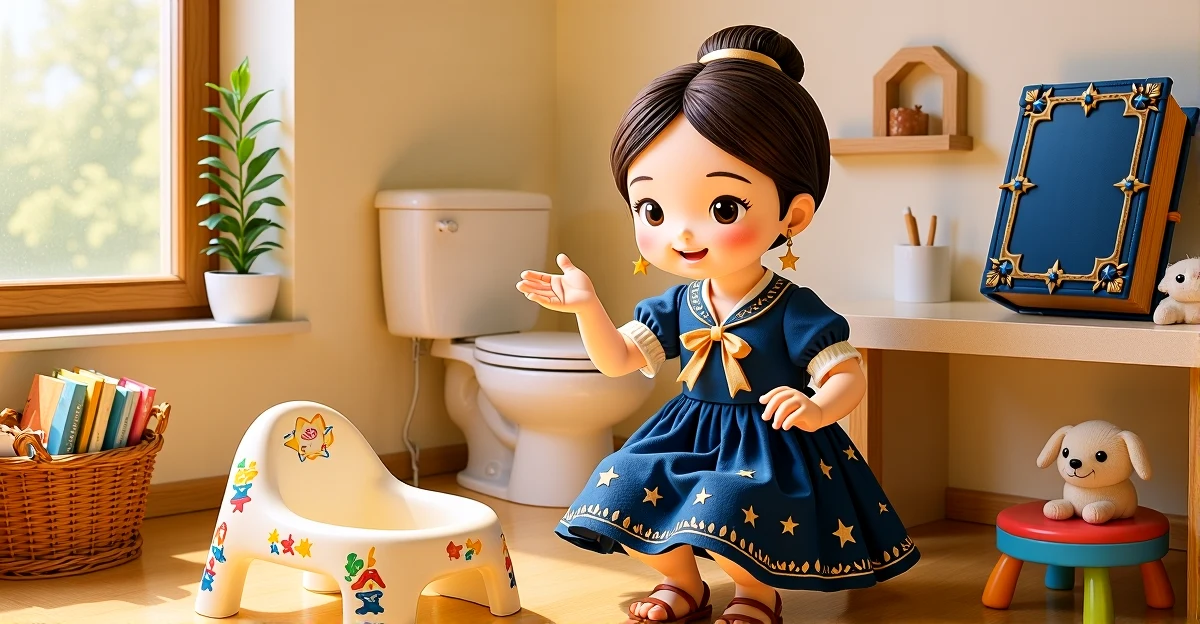

You've tried everything. The colorful potty chair with the fun stickers. The special underwear with their favorite characters. The gentle reminders, the patient encouragement, the celebration of every tiny success. And yet, your three or four-year-old is still having frequent accidents, still refusing to use the potty, still seeming completely uninterested in this whole toilet training thing.
And you're exhausted. Maybe you're hearing from family members about when their children were trained. Maybe you're worried about preschool requirements. Maybe you're just wondering what you're doing wrong.
Here's what the Magic Book taught me, and what I want you to know right from the start: You are not doing anything wrong. Your child is not broken. And what you're experiencing is one of the MOST common challenges of early childhood. In this post, we're going to explore what's really happening when your child resists toilet training, what the research tells us about this developmental phase, and most importantly, how you can support your child through this journey with patience, understanding, and love.
What's Really Happening: The Autonomy Discovery Phase
When your little one is between ages three and four, something absolutely WONDERFUL is happening in their development. Their brain is discovering something called autonomy. That's a big word, but it means they're realizing something profound: Oh my goodness, I am my own person! I can make choices! I have control over my own body!
This is beautiful. This is exactly what's supposed to happen at this age. Your child's brain is growing in precisely the way it needs to grow.
Now, here's where it gets interesting. Toilet training happens to fall right in the middle of this autonomy discovery phase. And your child's brilliant little brain is thinking: Wait a minute, this is MY body. I get to decide what happens with MY body. And sometimes, that means they want to make their own choices about when and how they use the potty.
This isn't defiance. This is development. This is your child's brain growing exactly the way it's meant to grow.
Why This Feels Like Resistance
From your perspective as a parent, it can feel like your child is being stubborn or difficult. But from your child's perspective, they're practicing one of the most important skills of early childhood: making decisions about their own body. They're learning that they have agency, that their choices matter, that they are separate individuals with their own will.
The American Academy of Pediatrics notes that emotional issues profoundly affect toilet training, including a child's desire for independence and self-mastery. Children need to control some aspects of their lives, and toileting becomes a natural arena for this developmental need. When we understand this, everything shifts.
What Research Tells Us About Toilet Training
Let me share what the research tells us, because this is SO important and can completely change how you approach this challenge.
Dr. Cara Goodwin, a licensed clinical psychologist who specializes in child development, has studied toilet training extensively. She found something fascinating: the sweet spot for toilet training is usually between twenty-seven and thirty-two months. But here's the thing that might surprise you. Children who start training after this window often complete the process MORE quickly than children who start earlier.
Why? Because they have more emotional readiness. They have more language skills. They have more understanding of their own bodies. And most importantly, they have a stronger sense of autonomy, which means they can participate in the process as partners, not just as children being trained.
A more positive approach may reduce the time it takes a child to toilet train. Parents who praise bowel movements and avoid negative language see significantly faster progress.
— Dr. Cara Goodwin, Ph.D., Licensed Clinical Psychologist
Recent pediatric research confirms that toilet refusal may be observed after toilet training attempts, especially during the period crucial for a sense of autonomy. Certain developmental factors during this autonomy phase contribute to toileting resistance. Understanding the developmental context is essential for addressing toilet training challenges.
The Power of Emotional Readiness
Physical readiness is important, yes. Your child needs to be able to recognize the signals their body sends, to hold their bladder for reasonable periods, to pull their pants up and down. But emotional readiness is just as important, if not more so.
Emotional readiness means your child feels safe trying something new. It means they feel a sense of control over the process. It means they want to learn this skill, not because they're being forced, but because they're ready to take this step toward independence.
When we push toilet training before emotional readiness, we often create more resistance. When we wait for emotional readiness and support it with patience and encouragement, the process becomes so much smoother.
Gentle Strategies That Actually Work
So what does this mean for you, right now, in your home, with your beautiful child who might be having accidents or refusing the potty? Let me share some strategies that align with what the research tells us and what the Magic Book has taught me about supporting children through big developmental leaps.
1. Remove the Pressure
I know this is hard, especially if you're hearing from family members or friends about when their children were trained, or if you're facing preschool deadlines. But pressure creates resistance. When your child feels like toilet training is something they HAVE to do, their autonomy-seeking brain says: Oh really? Watch me NOT do it then!
But when toilet training feels like something they GET to do, something they're learning as a big kid skill, something they have choice and control over, their brain says: Oh, this is interesting! I want to try this!
Take a deep breath. Your child WILL learn this skill. Every child does, in their own time, in their own way.
2. Celebrate the Small Steps
Every time your child sits on the potty, even if nothing happens, that's progress. Every time they tell you they need to go, even if it's too late, that's progress. Every time they show interest in the potty, that's progress.
Learning happens in tiny sparkles, not giant leaps. And every sparkle deserves celebration. Use positive language: Wow, you're learning to listen to your body! That's amazing! Your words create your child's internal voice.
3. Use Positive Language
Research shows that parents who praise their children's efforts and avoid negative words like stinky or gross or yucky see faster progress. When you say things like: You're learning to use the potty like a big kid! or I'm so proud of you for trying! your child thinks: Yes, I AM learning! I CAN do this!
Avoid making accidents into big deals. A simple: Oops, accidents happen while we're learning. Let's clean up together! keeps the experience neutral and learning-focused rather than shame-based.
4. Honor Their Unique Timeline
Some children train in weeks. Some take months. Some have long periods of success and then suddenly have accidents again. All of this is normal. All of this is okay. Your child is not a robot following a program. They're a unique human being with their own developmental rhythm.
If your child has a younger sibling, they might actually be MORE interested in toilet training because they want to do big kid things. But they also might regress sometimes because they see the baby getting attention. Both of these are normal. Just keep offering gentle encouragement and celebrating every step forward.
5. Make It Comfortable and Fun
If your child seems anxious about the potty, make it less scary. Let them decorate the bathroom with stickers. Let them choose special underwear with their favorite characters. Let them bring a book or a small toy to hold while they sit. The more comfortable and in control they feel, the more willing they'll be to try.
If your child is having frequent accidents, check in about whether they might be constipated. Hard bowel movements can make children afraid of using the potty, and that fear can show up as resistance. Make sure they're drinking plenty of water and eating fiber-rich foods.
6. Invite, Don't Force
If your child is resistant to sitting on the potty at all, don't force it. Forcing creates power struggles, and power struggles create more resistance. Instead, invite them: I'm going to sit on the potty now. Would you like to sit on yours too? Or: It's potty time! Let's go together! Make it a fun routine, not a battle.
A Story That Can Help
In The Book of Inara, we have a beautiful story that speaks directly to this challenge of learning new skills at your own pace:
The Garden of Growing Steps
Perfect for: Ages 2-3 (which includes 3-4 year olds)
What makes it special: This story beautifully addresses the core challenge of toilet training resistance by celebrating that every child has their own unique way of trying and learning new skills. Milo and Nana discover a magical practice garden where every small effort makes flowers bloom. They learn that their different approaches to the garden are both valuable, which perfectly mirrors how children approach toilet independence at their own pace.
Key lesson: When Milo and Nana discover that their unique ways of trying make different flowers bloom, children learn that there is no single right way to master new skills. Their own approach is special and valuable. The magical stepping stones that bloom with effort validate the small steps children take toward independence.
How to use it: After you read this story with your child, you can remind them: Just like Milo and Nana each had their own special way of making flowers grow, you have your own special way of learning to use the potty. Every small step you take is making something beautiful bloom.
You're Doing Beautifully
The Magic Book reminds me that patience is one of the greatest gifts we can give our children. And patience doesn't mean waiting passively. It means actively supporting, actively encouraging, actively celebrating, while also trusting that your child's brain and body know what they're doing.
Your child is learning one of the most complex skills of early childhood: understanding and responding to their own body's signals while also navigating this huge developmental leap of autonomy. That's a LOT for a little person!
So tonight, or tomorrow, whenever feels right, snuggle up with your little one and read The Garden of Growing Steps together. Talk about how Milo and Nana each had their own special way of trying. Ask your child what their special way of learning new things is. Celebrate their unique approach.
And then, with love and patience and trust, continue supporting them on their toilet training journey. Celebrate the small steps. Use positive language. Remove the pressure. Honor their timeline.
You are doing BEAUTIFULLY. Your child is lucky to have a parent who cares enough to learn about their development, who wants to support them with understanding and patience.
The Magic Book and I are always here for you, cheering you on, believing in you and your wonderful child.
With love and starlight,
Inara
Related Articles
- Why Your Child Follows You Everywhere and How to Build Independent Play
- Understanding Your Child's 'No' Phase: Why Defiance is Actually Healthy Development
- Understanding Your Child's Fear of the Dark: A Gentle Parenting Guide
- Why Your Child Won't Use the Bathroom at School (And How to Help)
- Understanding Self-Care Resistance in Preschoolers: A Gentle Guide
Show transcript
Hello, my wonderful friend! It's me, Inara, and I am SO happy you're here today. You know, the Magic Book and I have been noticing something lately. Many parents are reaching out about toilet training, and specifically about when their little ones seem to resist using the potty. And I want you to know something right from the start. You are not alone in this. In fact, this is one of the MOST common experiences parents have, and there is so much beautiful wisdom we can share about it.
So grab a cozy cup of tea, settle in, and let's talk about what's really happening when your child is learning toilet independence, and more importantly, how we can support them through this amazing developmental journey.
First, let me tell you what the Magic Book taught me about this phase. When your little one is between ages three and four, something absolutely WONDERFUL is happening in their development. Their brain is discovering something called autonomy. That's a big word, but it means they're realizing, oh my goodness, I am my own person! I can make choices! I have control over my own body!
And you know what? That is BEAUTIFUL. That is exactly what's supposed to happen at this age.
Now, here's where it gets interesting. Toilet training happens to fall right in the middle of this autonomy discovery phase. And your child's brilliant little brain is thinking, wait a minute, this is MY body. I get to decide what happens with MY body. And sometimes, that means they want to make their own choices about when and how they use the potty.
This isn't defiance, my friend. This is development. This is your child's brain growing exactly the way it's meant to grow.
Let me share what the research tells us, because this is SO important. Dr. Cara Goodwin, a wonderful child psychologist, has studied toilet training extensively. And she found something fascinating. The sweet spot for toilet training is usually between twenty-seven and thirty-two months. But here's the thing. Children who start training after this window often complete the process MORE quickly than children who start earlier.
Why? Because they have more emotional readiness. They have more language skills. They have more understanding of their own bodies. And most importantly, they have a stronger sense of autonomy, which means they can participate in the process as partners, not just as children being trained.
The American Academy of Pediatrics tells us something beautiful too. They say that emotional growth is just as important as physical readiness for toilet training. Your child needs to feel a sense of independence and self-mastery. They need to feel like this is something they're learning to do, not something being done TO them.
And when we understand this, everything shifts.
So let's talk about what this means for you, right now, in your home, with your beautiful child who might be having accidents or refusing the potty.
First, take a deep breath. You are doing WONDERFULLY. Your child is not broken. They're not behind. They're not being difficult. They are learning one of the most complex skills of early childhood, which is understanding and responding to their own body's signals while also navigating this huge developmental leap of autonomy.
That's a LOT for a little person!
Here's what the Magic Book whispers to me about supporting children through this journey. Number one, remove the pressure. I know that's hard, especially if you're hearing from family members or friends about when their children were trained. But pressure creates resistance. When your child feels like toilet training is something they HAVE to do, their autonomy-seeking brain says, oh really? Watch me NOT do it then!
But when toilet training feels like something they GET to do, something they're learning as a big kid skill, something they have choice and control over, their brain says, oh, this is interesting! I want to try this!
Number two, celebrate the small steps. Every time your child sits on the potty, even if nothing happens, that's progress. Every time they tell you they need to go, even if it's too late, that's progress. Every time they show interest in the potty, that's progress. The Magic Book taught me that learning happens in tiny sparkles, not giant leaps. And every sparkle deserves celebration.
Number three, use positive language. Research shows that parents who praise their children's efforts and avoid negative words like stinky or gross or yucky see faster progress. Your words create your child's internal voice. When you say, wow, you're learning to listen to your body! That's amazing! Your child thinks, yes, I AM learning! I CAN do this!
Number four, honor their unique timeline. Some children train in weeks. Some take months. Some have long periods of success and then suddenly have accidents again. All of this is normal. All of this is okay. Your child is not a robot following a program. They're a unique human being with their own developmental rhythm.
And here's something the Magic Book showed me that I absolutely love. We have a story called The Garden of Growing Steps. It's about Milo and Nana discovering a magical practice garden where every small effort makes flowers bloom. And they learn something beautiful. They learn that their unique ways of trying are special gifts that help beautiful things grow.
Milo approaches the garden gently and carefully. Nana approaches it with energy and enthusiasm. And you know what? Both of their approaches make flowers bloom! Different flowers, beautiful flowers, but flowers nonetheless.
This story is PERFECT for children learning toilet independence because it teaches them that there's no single right way to learn something new. Their way of learning, their pace, their approach, it's all valuable. It's all special. It's all making something beautiful bloom.
After you read this story with your child, you can remind them. Just like Milo and Nana each had their own special way of making flowers grow, you have your own special way of learning to use the potty. And every small step you take is making something beautiful bloom.
Let me share a few more practical strategies that align with what the research tells us. If your child is having frequent accidents, check in about whether they might be constipated. Hard bowel movements can make children afraid of using the potty, and that fear can show up as resistance. Make sure they're drinking plenty of water and eating fiber-rich foods.
If your child seems anxious about the potty, make it less scary. Let them decorate the bathroom with stickers. Let them choose special underwear with their favorite characters. Let them bring a book or a small toy to hold while they sit. The more comfortable and in control they feel, the more willing they'll be to try.
If your child is resistant to sitting on the potty at all, don't force it. Forcing creates power struggles, and power struggles create more resistance. Instead, invite them. Say, I'm going to sit on the potty now. Would you like to sit on yours too? Or, it's potty time! Let's go together! Make it a fun routine, not a battle.
And here's something beautiful. If your child has a younger sibling, they might actually be MORE interested in toilet training because they want to do big kid things. But they also might regress sometimes because they see the baby getting attention. Both of these are normal. Just keep offering gentle encouragement and celebrating every step forward.
The Magic Book reminds me that patience is one of the greatest gifts we can give our children. And patience doesn't mean waiting passively. It means actively supporting, actively encouraging, actively celebrating, while also trusting that your child's brain and body know what they're doing.
Your child WILL learn this skill. I promise you. Every child does, in their own time, in their own way. And when they do, it will be because they felt safe, supported, and in control of their own learning journey.
So tonight, or tomorrow, whenever feels right, snuggle up with your little one and read The Garden of Growing Steps together. Talk about how Milo and Nana each had their own special way of trying. Ask your child what their special way of learning new things is. Celebrate their unique approach.
And then, with love and patience and trust, continue supporting them on their toilet training journey. Celebrate the small steps. Use positive language. Remove the pressure. Honor their timeline.
You are doing BEAUTIFULLY, my friend. Your child is lucky to have a parent who cares enough to learn about their development, who wants to support them with understanding and patience.
The Magic Book and I are always here for you, cheering you on, believing in you and your wonderful child.
Sweet dreams, and happy learning!
With love and starlight, Inara.