
Hello, wonderful parent. If you've noticed that your child doesn't always pick up on facial expressions, tone of voice, or body language the way other children seem to, I want you to take a deep breath and know something important: you are not alone in this, and what you're experiencing is actually a beautiful part of how children learn and grow.
Many parents come to me with this concern, and I can hear the worry in their voices. They wonder if something is wrong, if they've missed something, if their child will struggle socially. And I want to wrap you in the warmest cosmic hug and tell you this: your child is not behind. They are not struggling. They are learning. And learning takes time, patience, and gentle guidance.
In this guide, we're going to explore what research tells us about social awareness development, why some children need more support in this area than others, and most importantly, the beautiful ways you can help your child develop these skills. We'll also discover stories that can be your companions on this journey. So settle in, take a breath, and let's talk about the wonderful, complex skill of reading social cues.
Understanding Social Awareness as a Developmental Skill
Here's something WONDERFUL that I want you to understand right from the start: the ability to read facial expressions, interpret tone of voice, and understand body language is not something children are born knowing. It's a skill that develops gradually over time, just like learning to read words on a page or ride a bicycle.
Think about that for a moment. Your child isn't missing these cues because something is fundamentally wrong. They're in the process of learning to read them. And children between ages five and six are right in the middle of this learning journey. Their brains are actively working on this skill in this very moment, with every interaction they have.
The National Center for Biotechnology Information has conducted fascinating research on this topic. They found that five and six year old children are actively developing the ability to use nonverbal cues to make inferences about social relationships and power dynamics. Actively developing. That means your child's brain is building neural pathways, making connections, and learning something new about human communication every single day.
When we understand this, everything shifts. Instead of seeing our children as lacking a skill, we can see them as learners who are building a skill. Instead of worrying, we can support. Instead of correcting, we can teach. Instead of feeling frustrated, we can feel excited about being part of their learning journey.
Why Some Children Need More Support
Just like some children learn to read earlier and some learn later, some children pick up on social cues more quickly and some need more time and practice. This variation is completely normal and part of typical development.
There are many reasons why a child might need more support in this area. Some children are more focused on their internal world of thoughts and imagination. Some are deeply engaged in other types of learning, like understanding how things work or exploring creative ideas. Some simply process information differently, and that's not a deficit, it's a difference.
What matters most is not how quickly your child develops this skill, but that they have patient, loving support as they learn. And that's exactly what you're providing by being here, by seeking to understand, by wanting to help.
What Research Shows About Social Awareness Development
The research on social awareness development is both fascinating and deeply reassuring. Let me share what experts have discovered.
The National Association for the Education of Young Children emphasizes something really empowering: parents and teachers can intentionally teach and enhance social emotional skills using evidence based strategies to model and reinforce positive behaviors. Did you catch that? You can teach this. You have the power to help your child develop these skills through simple, loving, everyday interactions.
When adults name emotions, point out facial expressions, and discuss tone of voice in everyday situations, children develop stronger social awareness skills.
— Research on Social-Emotional Learning
Studies demonstrate that playful practice with emotion recognition, combined with patient coaching during real social interactions, helps children build confidence in reading nonverbal cues. The key is creating a supportive environment where children feel safe practicing these skills without pressure or judgment.
The Raising Children Network Australia reminds us that parents can support this development by being aware of their own nonverbal communication and using it intentionally. When you make your own facial expressions more obvious, when you name your emotions out loud, when you point out what your body language is showing, you're giving your child a living textbook of emotional expressions.
Gentle Strategies That Work
Now let's talk about the beautiful, practical ways you can support your child's growing social awareness. These strategies are backed by research and infused with warmth and playfulness.
Become a Feelings Narrator
Throughout your day, name the emotions you see in yourself and others. This is one of the most powerful things you can do. When you're reading a book together, pause and say, "Look at this character's face. Their eyebrows are scrunched up and their mouth is turned down. I think they might be feeling sad or worried. What do you think?"
When you're at the park, you might say, "See how that child is smiling really big and jumping up and down? Their body is showing us they're feeling excited and happy." You're teaching your child to connect facial expressions and body language with the emotions behind them.
Make Your Own Nonverbal Communication Visible
When you're happy, let your whole face show it. When you're concerned, let your child see your furrowed brow. Then name it. "I'm making this face because I'm feeling a little worried about something. Do you see how my forehead has lines in it? That's what my face does when I'm worried."
This explicit teaching is SO valuable. You're not expecting your child to figure it out on their own. You're being their gentle guide, showing them the map of human emotions written on faces and bodies.
Play Emotion Guessing Games
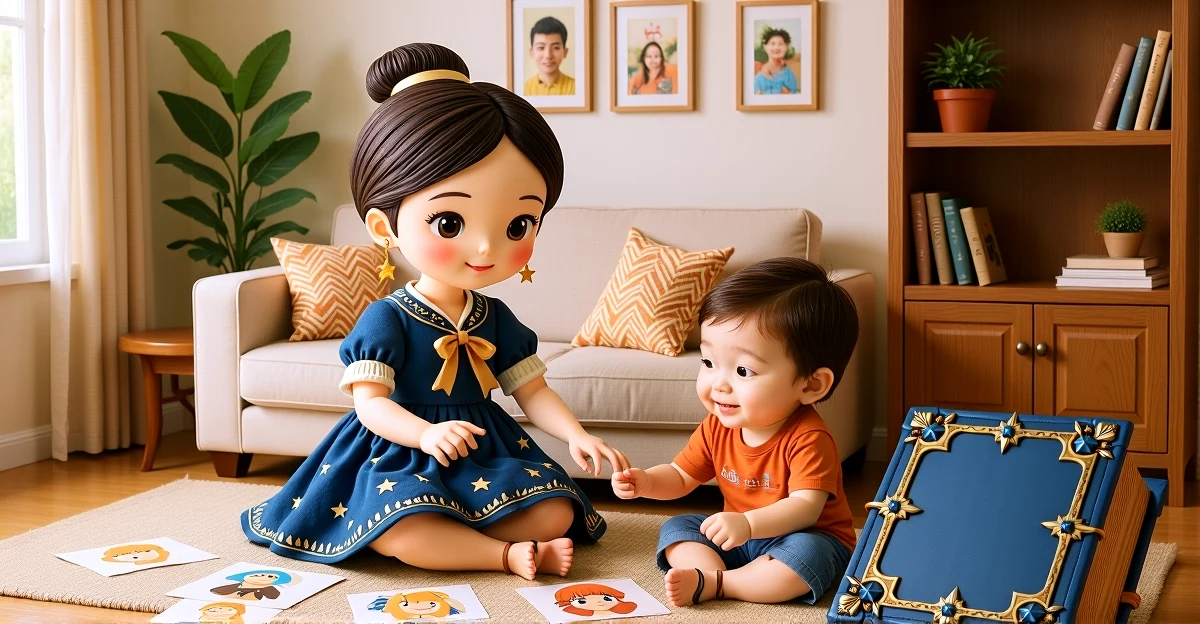
Make this fun! Make silly faces and have your child guess what you're feeling. Look through family photos and talk about what everyone might have been feeling when the picture was taken. Watch a favorite show together and pause it to discuss what characters might be thinking or feeling based on their expressions and body language.
When you make it playful, when you make it a game rather than a lesson, your child's brain is more open to learning. They're relaxed, they're engaged, and they're building skills without even realizing it.
Practice with Tone of Voice
Say the same sentence in different ways. Try saying "I'm so happy to see you" in a happy voice, then a sad voice, then an excited voice, then a tired voice. Let your child hear how the same words can mean different things depending on how they're said.
This is such a powerful way to help them understand that communication is about more than just words. It's about the music behind the words, the emotion carried in the voice.
Be Patient with the Process
Here's something really important: there is no race. There is no deadline. There is only your child's unique learning journey, and you get to be their gentle guide. Some days will feel like breakthroughs. Some days will feel like you're starting over. That's all part of learning.
Celebrate the small moments when your child notices someone's feelings or responds to a tone of voice. Those moments are evidence of their growing skills. Those moments are proof that your gentle teaching is working.
Stories That Can Help
In The Book of Inara, we have beautiful stories that bring these concepts to life for your child. Let me tell you about one that might be a perfect companion on this journey:
Gerda and the Snow Queen
Perfect for: Ages 6-7 (appropriate for advanced 5-6 year olds)
What makes it special: This is a tale of a brave girl named Gerda who goes on a magical journey to save her best friend Kay from the Snow Queen's cold magic. Throughout her adventure, Gerda demonstrates such beautiful social awareness. She encounters different characters, and she reads their emotions and responds with kindness and compassion. She understands what others are feeling, and that understanding helps her connect with them and ultimately save her friend.
Key lesson: When we pay attention to how others are feeling and respond with empathy, we create meaningful connections and can help those we love.
How to use this story: After you read this story with your child, you can talk about how Gerda knew what others were feeling. You can discuss the moments when she showed empathy and understanding. You can practice together, looking at the illustrations and talking about the facial expressions and body language of the characters. It becomes a gentle, story based way to explore these social skills.
You're Doing Beautifully
Remember, wonderful parent, your child is not behind. They are not struggling. They are learning. And learning takes time and patience and practice. Every time you name an emotion, every time you point out a facial expression, every time you discuss tone of voice, you are teaching your child the beautiful, complex language of human connection.
The Magic Book whispers this truth to me, and I want to share it with you: Social awareness is not about being perfect at reading every cue. It's about being curious, about paying attention, about caring enough to try to understand what others are feeling. And your child, with your gentle guidance, is developing that curiosity and that care.
You are doing such important work. You are teaching your child how to connect with others, how to understand emotions, how to navigate the social world with empathy and awareness. And that is one of the greatest gifts you can give them.
So take a deep breath. Trust the process. Celebrate the small moments. And know that the Magic Book and I are here with you on this journey. We believe in you, and we believe in your child.
With love and starlight, Inara
Related Articles
- Understanding How Children Learn Empathy: A Guide for Parents of 5-6 Year Olds
- Understanding Your Child's "Not My Problem" Phase: A Gentle Parenting Guide
- Why Your Child Says Good or Bad for Every Feeling (And How to Help Them Express the Full Rainbow of Emotions)
- Understanding Your Child's Growing Empathy: A Guide for Ages 5-6
- Nurturing Deep Empathy and Compassion in Young Children: A Gentle Guide
Show transcript
Hello, wonderful parent! It's me, Inara, and I am so happy you're here today. You know, the Magic Book and I have been noticing something that many parents are experiencing, and I want you to know right from the start that you are not alone in this. If your child seems to miss social cues, if they don't always pick up on facial expressions or tone of voice or body language, I want you to take a deep breath and know that what you're experiencing is actually a beautiful part of how children learn and grow.
Let me share something WONDERFUL with you. The research shows us that understanding social cues and nonverbal communication is not something children are born knowing. It's a skill that develops gradually over time, and children between ages five and six are right in the middle of this learning journey. Think about that for a moment. Your child isn't missing these cues because something is wrong. They're learning to read them, just like they're learning to read words on a page. And just like reading takes practice and patience and gentle guidance, so does learning to understand the subtle language of faces and voices and gestures.
The National Center for Biotechnology Information has done fascinating research on this, and they found that five and six year old children are actively developing the ability to use nonverbal cues to make inferences about social relationships. Actively developing. That means your child's brain is working on this skill right now, in this very moment. Every interaction they have is teaching them something new about how people communicate without words.
Here's what the Magic Book taught me, and this changed everything for me. When we see our children as learners rather than as struggling, when we understand that they're building a skill rather than lacking one, our whole approach shifts. Instead of worrying, we can support. Instead of correcting, we can teach. Instead of feeling frustrated, we can feel excited about being part of their learning journey.
The research from the National Association for the Education of Young Children tells us something really empowering. They emphasize that parents and teachers can intentionally teach and enhance social emotional skills using evidence based strategies to model and reinforce positive behaviors. Did you catch that? You can teach this. You have the power to help your child develop these skills through simple, loving, everyday interactions.
So what does that look like? Let me share some beautiful ways you can support your child's growing social awareness.
First, become a feelings narrator. Throughout your day, name the emotions you see in yourself and others. When you're reading a book together, pause and say, look at this character's face. Their eyebrows are scrunched up and their mouth is turned down. I think they might be feeling sad or worried. What do you think? When you're at the park, you might say, see how that child is smiling really big and jumping up and down? Their body is showing us they're feeling excited and happy. You're teaching your child to connect facial expressions and body language with the emotions behind them.
Second, make your own nonverbal communication more obvious and intentional. The Raising Children Network Australia reminds us that parents can support this development by being aware of their own nonverbal communication and using it intentionally. So when you're happy, let your whole face show it. When you're concerned, let your child see your furrowed brow. Then name it. I'm making this face because I'm feeling a little worried about something. Do you see how my forehead has lines in it? That's what my face does when I'm worried. You're giving your child a living textbook of emotional expressions.
Third, play emotion guessing games. Make silly faces and have your child guess what you're feeling. Look through family photos and talk about what everyone might have been feeling when the picture was taken. Watch a favorite show together and pause it to discuss what characters might be thinking or feeling based on their expressions and body language. Make it playful, make it fun, make it a game rather than a lesson.
Fourth, practice with tone of voice. Say the same sentence in different ways. Try saying I'm so happy to see you in a happy voice, then a sad voice, then an excited voice, then a tired voice. Let your child hear how the same words can mean different things depending on how they're said. This is such a powerful way to help them understand that communication is about more than just words.
And here's something really important. Some children need more time and more practice with these skills than others, and that is completely normal. Just like some children learn to read earlier and some learn later, some children pick up on social cues more quickly and some need more support. There is no race. There is no deadline. There is only your child's unique learning journey, and you get to be their gentle guide.
The research is so clear on this. When adults name emotions, point out facial expressions, and discuss tone of voice in everyday situations, children develop stronger social awareness skills. When we provide playful practice with emotion recognition combined with patient coaching during real social interactions, children build confidence in reading nonverbal cues. The key is creating a supportive environment where children feel safe practicing these skills without pressure or judgment.
Now, let me tell you about a story that might be a beautiful companion on this journey. In The Book of Inara, we have a story called Gerda and the Snow Queen. It's a tale of a brave girl named Gerda who goes on a magical journey to save her best friend Kay. Throughout her adventure, Gerda demonstrates such beautiful social awareness. She encounters different characters, and she reads their emotions and responds with kindness and compassion. She understands what others are feeling and that understanding helps her connect with them and ultimately save her friend.
After you read this story with your child, you can talk about how Gerda knew what others were feeling. You can discuss the moments when she showed empathy and understanding. You can practice together, looking at the illustrations and talking about the facial expressions and body language of the characters. It becomes a gentle, story based way to explore these social skills.
Remember, wonderful parent, your child is not behind. They are not struggling. They are learning. And learning takes time and patience and practice. Every time you name an emotion, every time you point out a facial expression, every time you discuss tone of voice, you are teaching your child the beautiful, complex language of human connection.
The Magic Book whispers this truth to me, and I want to share it with you. Social awareness is not about being perfect at reading every cue. It's about being curious, about paying attention, about caring enough to try to understand what others are feeling. And your child, with your gentle guidance, is developing that curiosity and that care.
You are doing such important work. You are teaching your child how to connect with others, how to understand emotions, how to navigate the social world with empathy and awareness. And that is one of the greatest gifts you can give them.
So take a deep breath. Trust the process. Celebrate the small moments when your child notices someone's feelings or responds to a tone of voice. Those moments are evidence of their growing skills. Those moments are proof that your gentle teaching is working.
The Magic Book and I are here with you on this journey. We believe in you, and we believe in your child. With love and starlight, Inara.