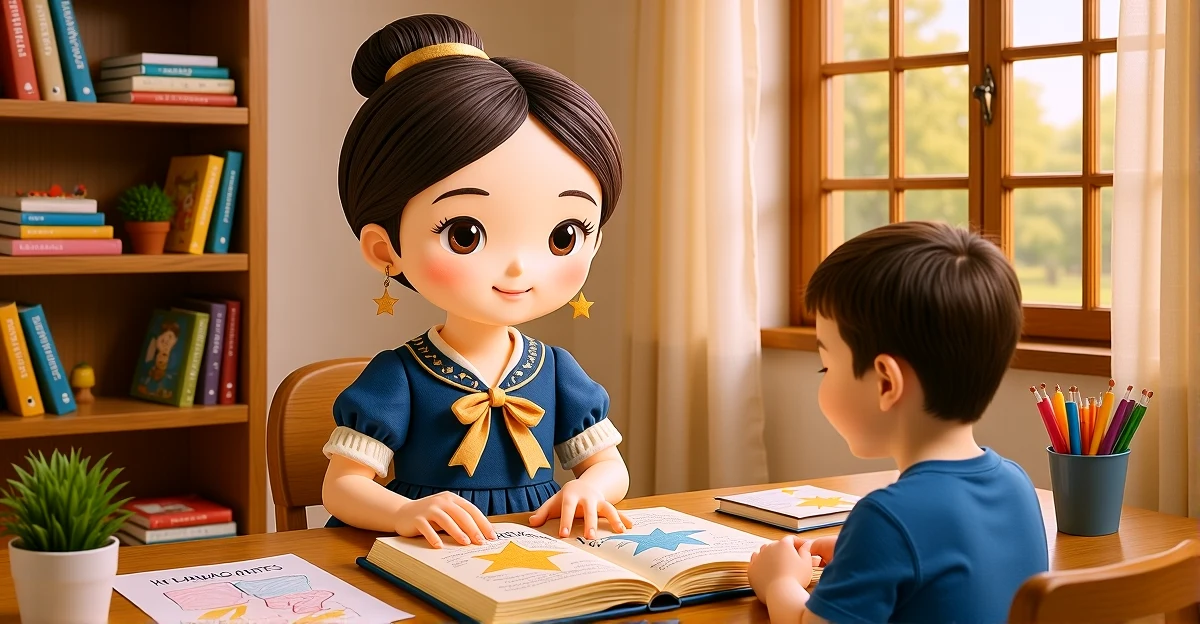

Hello, wonderful parent. If you are reading this, you might be watching your child hold back from trying new things at school - maybe they refuse to attempt math problems that look hard, or they avoid reading activities because they are not good at it yet, or they shut down completely when faced with a new subject. You see other children diving into challenges with enthusiasm, and you wonder: Why does my child give up before they even try?
Let me start by telling you something REALLY important: You are not alone in this. Thousands of parents are navigating this exact challenge right now. And here is the beautiful truth - what you are seeing is not stubbornness, laziness, or a character flaw. It is actually your child brain doing something incredibly sophisticated: protecting them from feeling inadequate.
In this post, I am going to share what research from Stanford University, the University of Chicago, and the National Academies of Sciences reveals about why children avoid challenges - and more importantly, how you can help your child develop what researchers call a growth mindset. You will discover specific language shifts that literally rewire how your child thinks about their own potential, and you will learn about stories that can help them embrace the beautiful adventure of learning.
What is Really Happening in Your Child Mind
When your child encounters something new that feels challenging - a tricky math problem, a reading passage with unfamiliar words, a science concept that does not click immediately - their brain is making incredibly sophisticated calculations. They are asking themselves a fundamental question: Am I the kind of person who can do this?
And here is where it gets fascinating. The answer they arrive at depends almost entirely on how they have learned to think about their own abilities. Dr. Carol Dweck of Stanford University, whose research has transformed educational psychology, calls this a growth mindset versus a fixed mindset.
The Fixed Mindset Trap
When children operate from a fixed mindset, they believe that being good at something means you should be good at it right away, without effort. In their mind, if something feels hard, that is evidence that they are not capable. So when they encounter math problems that require thinking, or reading that takes practice, or science concepts that need time to understand, their brain sends them a warning signal: This is hard, which means I am not good at it, which means I should avoid it to protect myself from feeling bad.
This is not a character flaw. This is learned thinking - which means it can be unlearned and replaced with something much more empowering.
What Research Reveals About Growth Mindset
Research from the University of Chicago has discovered something absolutely remarkable. Children as young as fourteen months are already forming beliefs about whether their abilities can grow and change, or whether they are fixed and unchangeable. And the most beautiful part? These beliefs are shaped primarily by the words they hear from the adults who love them.
Praising children for their effort encourages them to adopt incremental motivational frameworks - they believe ability is malleable, attribute success to hard work, enjoy challenges, and generate strategies for improvement.
— Dr. Carol S. Dweck, Stanford University
Dr. Elizabeth Gunderson longitudinal research demonstrates that the type of praise parents give young children predicts their motivational frameworks five years later. Think about that for a moment. The words you choose today are literally shaping how your child will approach challenges when they are in third grade, middle school, and beyond.
The Power of Process Praise
When parents use what researchers call process praise - praising effort and strategies instead of innate ability - children develop an incremental framework. They come to believe that their brain grows stronger through practice, that mistakes are valuable information, and that challenges are opportunities rather than threats.
The National Academies of Sciences has found that attention span and persistence in young children predict later academic achievement more reliably than early academic skills. In other words, your child willingness to stick with challenges matters more than whether they can already read or do math. And that willingness? It grows from how they learn to think about effort and mistakes.
The Role of Emotion Regulation
Dr. Paulo Graziano research adds another beautiful layer to this understanding. He found that children emotion regulation skills - their ability to manage the anxiety and frustration that naturally arise when learning something new - predict academic success even after accounting for IQ.
Think about it this way: when your child encounters a difficult math problem, they experience real emotions - maybe anxiety, maybe frustration, maybe even a little fear. If they have not learned to recognize these feelings as normal and temporary, those emotions can feel overwhelming. Their brain protective instinct kicks in and says Avoid this to avoid these uncomfortable feelings.
But when children learn that these feelings are just part of learning, that everyone feels them, and that they pass - suddenly challenge becomes manageable. The discomfort does not disappear, but it no longer controls their choices.
Children who regulate emotions well are more productive and accurate when completing classroom assignments. Emotion regulation facilitates children ability to independently attend to and learn new information.
— Dr. Paulo A. Graziano, University of North Carolina at Greensboro
Gentle Strategies That Build Academic Courage
Now that you understand what is happening in your child mind, let me share specific strategies you can start using today. These are not quick fixes - they are relationship-based approaches that build genuine confidence over time.
1. Transform Your Praise Language
Instead of saying You are so smart when they succeed, try I love how you kept trying even when it was hard. Instead of You are a natural at this, try Your practice is really paying off. These small shifts in language literally rewire how your child brain interprets challenge.
- Instead of: You are so smart! → Try: I love how you figured that out!
- Instead of: You are a natural! → Try: Your hard work is showing!
- Instead of: This is easy for you! → Try: You have practiced this so much!
- Instead of: You are the best at this! → Try: Look how much you have improved!
2. Model Your Own Learning Process
Let your child see you struggle with something new. Say out loud This is tricky, but I am going to keep trying or I made a mistake, but that helps me learn what to do differently. Children learn more from what they see than what they hear. When they watch you embrace challenge, they learn that struggle is normal and valuable.
3. Reframe Mistakes as Teachers
When your child makes an error, respond with curiosity rather than correction. Oh, interesting! What do you think happened there? or That did not work the way you expected - what could you try differently? This teaches them that mistakes are teachers, not judgments.
4. Create a Challenge-Friendly Environment
Choose activities that are slightly beyond your child current ability - not so hard they are frustrating, but hard enough to require effort. Puzzles, building projects, cooking together - anything where they have to think and try and adjust. And most importantly, celebrate the effort and strategies they use, not just the outcome.
5. Build Emotion Regulation Tools
When they feel frustrated with a challenge, acknowledge the feeling: I can see this is making you feel frustrated. That is a normal feeling when we are learning something new. Then help them develop strategies: Let us take three deep breaths together or Sometimes when I feel stuck, I take a little break and come back to it.
Stories That Can Help
In The Book of Inara, we have a beautiful story that brings these concepts to life for your child in the most magical way:
The Learning Voyage
Perfect for: Ages 4-5 (and wonderful for 5-6 year olds too!)
What makes it special: Ethan and Sofia discover a magical cruise ship where every mistake becomes a wonderful learning experiment. The ship has cozy spaces that remember and celebrate each attempt at trying something new. When the children make mistakes, the ship does not judge them - it honors their courage for trying.
Key lesson: This story beautifully captures what we want children to understand - that learning is a journey, not a destination. That mistakes are not failures - they are proof that you are brave enough to try something new. That the process of learning is where the real magic happens.
After reading together: You can create your own learning voyage at home. When your child tries something difficult, celebrate the attempt before you even look at the result. Say things like I love how you tried that even though it was hard or Your brain just grew stronger from that challenge.
You are Doing Beautifully
Your child current hesitation about new challenges is not a character flaw or a permanent limitation. It is simply where they are right now in their learning journey. And you, wonderful parent, have the power to guide them toward a more empowering way of thinking about their own potential.
Every time you praise their effort instead of their intelligence, every time you celebrate their courage to try instead of their success, every time you model your own learning process - you are literally shaping the neural pathways in their developing brain. You are teaching them that they are capable of growth, that challenges are opportunities, and that their potential is not fixed but expandable.
This is the gift of a growth mindset. This is the foundation of academic courage. And it starts with the words you choose and the beliefs you help them build about themselves.
The research is absolutely clear on this: children who develop a growth mindset and strong emotion regulation skills do not just do better academically - they develop resilience, creativity, and confidence that serves them throughout their entire lives.
The Magic Book and I believe in your child infinite potential. And we believe in you, wonderful parent, as you guide them toward discovering their own strength and courage.
With love and starlight,
Inara
Related Articles
- When Your Child Dismisses Effort: Understanding Growth Mindset in Young Children
- When Your Child Avoids New Academic Subjects: A Growth Mindset Guide
- Why Your Child Melts Down Over Feedback (And How to Build Growth Mindset)
- Nurturing Scientific Curiosity in Your 5-6 Year Old: A Gentle Guide
- Understanding Personal Growth and Change: A Guide for Parents of 5-6 Year Olds
Show transcript
Hello, wonderful parent. I am Inara, and I want to talk with you today about something I see so often - when your child avoids trying new things at school, especially subjects or activities they are not immediately good at. If you are watching this, you might be feeling worried, maybe even a little frustrated. You see other children diving into new challenges while your little one holds back, and you wonder what is happening.
Let me start by telling you something REALLY important: what you are seeing is completely normal development. Your child is not being stubborn or lazy. They are actually showing you something beautiful about how their brain is learning to protect them. And here is the wonderful news - you have the power to help them transform this protective instinct into genuine courage and curiosity.
Let me explain what is really happening in your child mind. When children around ages five and six encounter something new that feels challenging, their brains are making incredibly sophisticated calculations. They are asking themselves: Am I the kind of person who can do this? And here is where it gets fascinating - the answer they arrive at depends almost entirely on how they have learned to think about their own abilities.
Research from Stanford University and the University of Chicago has discovered something absolutely remarkable. Children as young as fourteen months are already forming beliefs about whether their abilities can grow and change, or whether they are fixed and unchangeable. Dr. Carol Dweck calls this a growth mindset versus a fixed mindset. And the most beautiful part? These beliefs are shaped primarily by the words they hear from the adults who love them.
When your child avoids new academic challenges, they are often operating from what researchers call a fixed mindset. In their mind, being good at something means you should be good at it right away, without effort. So when they encounter math problems that feel hard, or reading that requires practice, or science concepts that do not click immediately, their brain sends them a warning signal: This is hard, which means I am not good at it, which means I should avoid it to protect myself from feeling bad.
But here is the truly wonderful news - this is not permanent. This is a learned pattern, which means it can be unlearned and replaced with something much more empowering.
The National Academies of Sciences has found that attention span and persistence in young children predict later academic achievement more reliably than early academic skills. In other words, your child willingness to stick with challenges matters more than whether they can already read or do math. And that willingness? It grows from how they learn to think about effort and mistakes.
Let me share something that might change how you talk with your child starting today. Research shows that when parents praise effort and strategies instead of innate ability, children develop what is called an incremental framework. They come to believe that their brain grows stronger through practice, that mistakes are valuable information, and that challenges are opportunities rather than threats.
So instead of saying You are so smart when they succeed, try saying I love how you kept trying even when it was hard. Instead of You are a natural at this, try Your practice is really paying off. These small shifts in language literally rewire how your child brain interprets challenge.
Dr. Paulo Graziano research adds another beautiful layer to this understanding. He found that children emotion regulation skills - their ability to manage the anxiety and frustration that naturally arise when learning something new - predict academic success even after accounting for IQ. This means that helping your child develop emotional tools to handle challenge is just as important as any academic skill.
Think about it this way: when your child encounters a difficult math problem, they experience real emotions - maybe anxiety, maybe frustration, maybe even a little fear. If they have not learned to recognize these feelings as normal and temporary, those emotions can feel overwhelming. Their brain protective instinct kicks in and says Avoid this to avoid these uncomfortable feelings.
But when children learn that these feelings are just part of learning, that everyone feels them, and that they pass - suddenly challenge becomes manageable. The discomfort does not disappear, but it no longer controls their choices.
Now, I want to tell you about a story from The Book of Inara called The Learning Voyage. In this story, Ethan and Sofia discover a magical cruise ship where every mistake becomes a wonderful learning experiment. The ship has cozy spaces that remember and celebrate each attempt at trying something new. When the children make mistakes, the ship does not judge them - it honors their courage for trying.
This story beautifully captures what we want children to understand: that learning is a journey, not a destination. That mistakes are not failures - they are proof that you are brave enough to try something new. That the process of learning is where the real magic happens.
After reading this story with your child, you can create your own learning voyage at home. When your child tries something difficult, celebrate the attempt before you even look at the result. Say things like I love how you tried that even though it was hard or Your brain just grew stronger from that challenge.
Here are some specific strategies you can start using today. First, model your own learning process. Let your child see you struggle with something new. Say out loud This is tricky, but I am going to keep trying or I made a mistake, but that helps me learn what to do differently. Children learn more from what they see than what they hear.
Second, reframe mistakes as valuable information. When your child makes an error, respond with curiosity rather than correction. Oh, interesting! What do you think happened there? or That did not work the way you expected - what could you try differently? This teaches them that mistakes are teachers, not judgments.
Third, create a challenge-friendly environment at home. Choose activities that are slightly beyond your child current ability - not so hard they are frustrating, but hard enough to require effort. Puzzles, building projects, cooking together - anything where they have to think and try and adjust. And most importantly, celebrate the effort and strategies they use, not just the outcome.
Fourth, help them develop emotion regulation tools. When they feel frustrated with a challenge, acknowledge the feeling: I can see this is making you feel frustrated. That is a normal feeling when we are learning something new. Then help them develop strategies: Let us take three deep breaths together or Sometimes when I feel stuck, I take a little break and come back to it.
The research is absolutely clear on this: children who develop a growth mindset and strong emotion regulation skills do not just do better academically - they develop resilience, creativity, and confidence that serves them throughout their entire lives.
Your child current hesitation about new challenges is not a character flaw or a permanent limitation. It is simply where they are right now in their learning journey. And you, wonderful parent, have the power to guide them toward a more empowering way of thinking about their own potential.
Every time you praise their effort instead of their intelligence, every time you celebrate their courage to try instead of their success, every time you model your own learning process - you are literally shaping the neural pathways in their developing brain. You are teaching them that they are capable of growth, that challenges are opportunities, and that their potential is not fixed but expandable.
This is the gift of a growth mindset. This is the foundation of academic courage. And it starts with the words you choose and the beliefs you help them build about themselves.
The Magic Book and I believe in your child infinite potential. And we believe in you, wonderful parent, as you guide them toward discovering their own strength and courage.
With love and starlight, Inara.