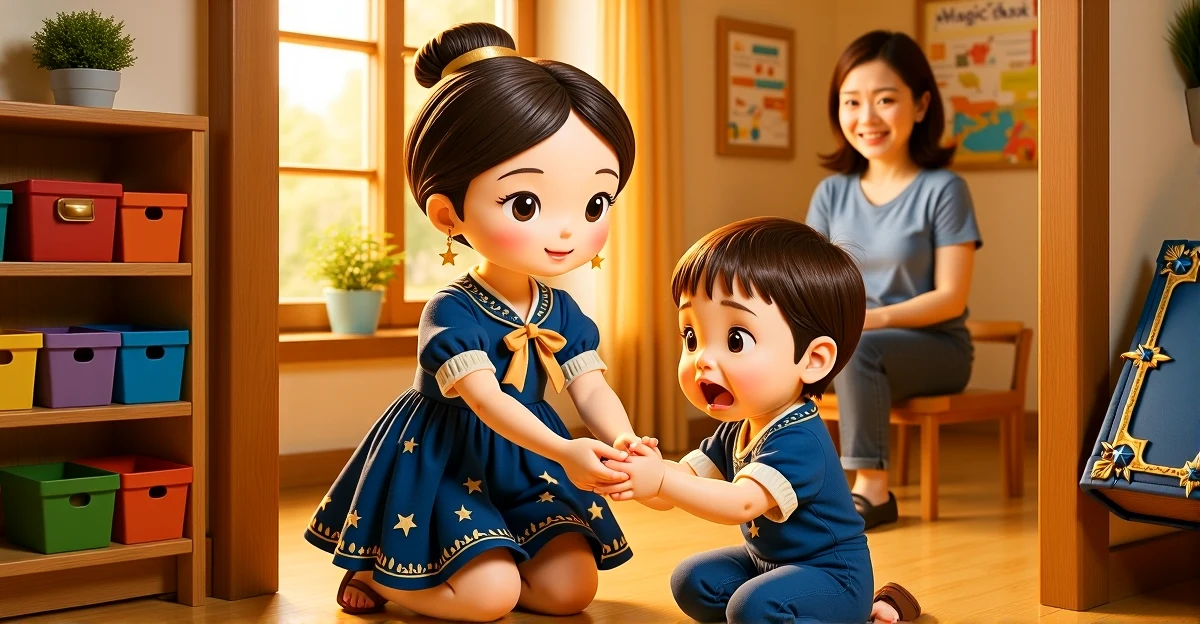

It's 8:15 AM, and you're standing in the preschool doorway. Your child has wrapped their arms around your legs, tears streaming down their face, begging you not to leave. Your heart breaks into a thousand pieces as you gently pry their fingers loose and walk away, hearing their cries echo down the hallway. You spend the whole morning wondering: Am I doing the right thing? Am I traumatizing my child? What am I doing wrong?
Oh, my wonderful friend, first let me say this: You're not alone. What you're experiencing is one of the most common challenges parents face during the preschool years. And here's something that might surprise you - those tears, that desperate clinging, that intense emotion? It's not a sign that something is wrong. It's actually evidence of something incredibly beautiful.
In this post, I'm going to share what the Magic Book has taught me about separation anxiety, what research tells us about why this happens, and gentle strategies that actually help. By the end, you'll understand that those morning tears are teaching your child some of the most important lessons of their life.
What Separation Anxiety Really Means
When your child screams at drop-off, when they cling to you with every ounce of strength in their little body, when they beg you not to go - here's the truth that changes everything: That intense emotion is evidence of healthy, secure attachment. Your child loves you SO much. They trust you SO deeply. And their developing brain is still learning that when you leave, you always come back.
Think about it from your child's perspective. For their entire life, you've been their safe place, their whole world, their constant. And now they're discovering that you can be apart. Can you imagine how big and scary that realization must feel for a three or four-year-old? Of course they protest. Of course they cry. They're not being difficult or manipulative. They're processing one of the biggest developmental leaps of early childhood.
The Developmental Context
Research shows us that separation anxiety typically peaks between ages two and four. This is exactly when children are developing awareness that they are separate beings from their caregivers. It's a crucial cognitive milestone - understanding that you and they are different people who can be in different places. But with that awareness comes fear. If we can be apart, will you come back? Will I be safe without you?
These questions are happening at a subconscious level, of course. Your child can't articulate them. But their tears and their clinging are their way of saying, "I need to know you'll return. I need to know I'm safe."
What Research Tells Us
The American Academy of Pediatrics offers something really hopeful: It's rare for separation anxiety to persist on a daily basis after the preschool years. This phase, as painful as it feels right now, is temporary. Your child is learning. Their brain is growing. And every single drop-off, even the hard ones, is teaching them that they are safe, that you will return, and that they can handle big feelings.
"Separation anxiety in 2-3 year olds represents normal developmental differentiation of anxiety symptoms and reflects healthy attachment patterns."
— Dr. Nicholas D. Mian, University of Massachusetts Boston
This research is SO important because it reframes what we're seeing. Those tears aren't a sign of poor adjustment or weak parenting. They're evidence of secure bonding. The very attachment that's causing these difficult mornings is also building the foundation for your child's future confidence and independence.
Studies show us that children with strong, secure attachments to their parents actually become MORE independent over time, not less. That bond you've built, that deep love and trust, that's what will eventually give your child the courage to explore the world. Right now, they're learning to trust that bond even when you're not physically present. That's huge developmental work.
Gentle Strategies That Actually Work
Understanding the why is powerful, but I know you also need practical strategies for those difficult mornings. Here's what research and experience show us actually helps:
1. Quick, Confident Goodbyes
I know this feels counterintuitive. I know it feels wrong to leave when your child is crying. But here's what the research shows: Quick, confident goodbyes work better than prolonged ones. When you linger, giving extra hugs, staying just a few more minutes, you're actually sending a mixed message. Your hesitation communicates uncertainty, and children pick up on that.
When you stay calm and consistent, even when your heart is breaking, you're sending your child a powerful message: I trust that you can do this. I trust your teachers. I trust that you'll be okay. And children feel that trust. It becomes their anchor.
2. Validate Feelings Without Amplifying Them
You can acknowledge your child's emotion without making it bigger than it needs to be. Try this: "I know you're feeling sad right now. It's hard to say goodbye. I feel sad too." You're validating their experience. You're not dismissing it. But then, with gentle confidence, you add: "And I know you're going to have a wonderful morning. I'll be back to pick you up right after snack time, just like always."
This approach teaches your child that feelings are okay AND that they can be sad and still be brave. Both things can be true at the same time.
3. Create a Goodbye Ritual
Rituals help children feel safe because they know what to expect. The predictability itself is comforting. Maybe it's three hugs and a kiss. Maybe it's a special handshake. Maybe it's looking out the window and waving until you can't see each other anymore. Whatever it is, make it consistent.
One family I know created a "goodbye dance" - three spins, two jumps, and a big hug. Their daughter loved it because it was THEIR special thing. It gave her something to focus on besides the fear of separation.
4. Trust What the Teachers Tell You
Here's something that might be hard to believe when you're walking away hearing those cries: The tears usually stop within minutes of you leaving. I know that sounds impossible. But it's true. Most children calm down quickly and engage with their day once the transition is complete.
Those tears are specifically about the transition, about saying goodbye to you. They're not about being unhappy at school all day long. Your child's teachers aren't just trying to make you feel better when they tell you this. They're telling you the truth.
5. Be Gentle With Yourself Too
These mornings are hard on you. It's okay to cry in the car after drop-off. It's okay to miss your child. It's okay to feel torn between knowing they need this experience and wishing you could keep them with you always. You're doing something incredibly brave. You're helping your child grow, even when it hurts your heart. That's what love looks like.
Stories That Can Help
In The Book of Inara, we have beautiful stories that bring these concepts to life for your child. Stories have a magical way of helping children understand their feelings and learn new skills. Here's one that's perfect for separation anxiety:
The Gentle Bells That Listen
Perfect for: Ages 4-5 (also wonderful for younger children experiencing school anxiety)
What makes it special: In this story, Kenji and Maeva discover that the school fire alarm bells can actually hear their feelings and respond with different gentle chimes. They learn that every emotion carries important wisdom when they listen carefully. What I love about this story is how it teaches children that their worried feelings at school are completely normal and valid.
Key lesson: When Kenji and Maeva discover that the bells respond to their emotions with gentle understanding, children learn that their feelings are heard, even in school settings. The story shows that feeling worried is just part of learning and growing, and that schools can be safe places that listen to their hearts.
How to use it: After you read this story together, try this. Help your child identify their feelings during drop-off. You could say, "I wonder if your heart is feeling worried right now, just like Kenji's heart felt worried." And then remind them, "Your school is a safe place that listens to your heart, just like those gentle bells listened to Kenji and Maeva's feelings."
You're Doing Beautifully
I want you to remember something really important. When you're standing there in the preschool doorway, heart aching, wondering if you're doing the right thing - you are. You're teaching your child that feelings are okay. That it's safe to be sad and still be brave. That you will always come back. That they can trust you. And those lessons, my wonderful friend, those are gifts that will serve them for their entire life.
The very attachment that's causing these difficult mornings is also building the foundation for your child's future confidence and independence. That bond you've built, that deep love and trust, that's what will eventually give them the courage to explore the world, to try new things, to become exactly who they're meant to be.
So be patient with your child. Be patient with yourself. This phase is temporary, but the lessons are forever. You're not doing anything wrong. You're doing everything right. And the Magic Book and I are here for you, every step of this journey.
May your mornings be filled with gentle courage, and may you always remember: Those tears are evidence of love. And love is what makes everything possible.
With stardust and wonder,
Inara
Related Articles
- Nurturing Cultural Pride in Preschoolers: A Gentle Guide for Ages 3-4
- Understanding Your Child's Social Development: Why Playing Alone is Normal (Ages 3-4)
- Teaching Your Preschooler to Appreciate Differences: A Gentle Guide for Parents
- Understanding Your Child's Rough Play: A Gentle Guide to Teaching Empathy
- Why Morning Routines Feel Like Battles (And the Gentle Approach That Works)
Show transcript
Hello, my wonderful friend. It's me, Inara, and I'm so glad you're here today. I want to talk with you about something that I know weighs heavy on many parents' hearts. Those morning drop-offs at preschool when your little one clings to you, tears streaming down their face, screaming as you try to leave. I see you. I see how hard this is. And I want you to know something really important right from the start. You are not doing anything wrong. Your child is not broken. And those tears? They're actually a sign of something beautiful.
Let me share what the Magic Book has taught me about this, because understanding what's really happening can change everything.
When your child screams for hours at drop-off, when they wrap their arms around your legs and beg you not to go, when your heart breaks into a thousand pieces as you walk away, here's the truth. That intense emotion, that desperate need to stay with you, is actually evidence of healthy, secure attachment. Your child loves you SO much. They trust you SO deeply. And their little brain is still learning that when you leave, you always come back.
Research shows us that separation anxiety typically peaks between ages two and four. This is exactly when children are developing awareness that they are separate beings from their caregivers. Can you imagine how big and scary that realization must feel? For their whole life, you've been their safe place, their whole world. And now they're discovering that you can be apart. Of course they protest. Of course they cry. They're not being difficult. They're processing one of the biggest developmental leaps of early childhood.
The American Academy of Pediatrics tells us something really hopeful. It's rare for separation anxiety to persist on a daily basis after the preschool years. This phase, as painful as it feels right now, is temporary. Your child is learning. Their brain is growing. And every single drop-off, even the hard ones, is teaching them that they are safe, that you will return, and that they can handle big feelings.
Now, I know that understanding the why doesn't make the mornings easier. So let me share some gentle strategies that research shows really help.
First, consistency is your friend. I know it's tempting to linger when they're crying, to give extra hugs, to stay just a few more minutes. But here's what the experts have found. Quick, confident goodbyes actually help children feel more secure over time. When you stay calm and consistent, even when your heart is breaking, you're sending them a powerful message. You're saying, I trust that you can do this. I trust your teachers. I trust that you'll be okay. And children feel that trust.
Second, validate their feelings without amplifying them. You can say, I know you're feeling sad right now. It's hard to say goodbye. I feel sad too. And then, with gentle confidence, you can add, And I know you're going to have a wonderful morning. I'll be back to pick you up right after snack time, just like always. You're acknowledging their emotion, you're not dismissing it, but you're also not making it bigger than it needs to be.
Third, create a goodbye ritual. Maybe it's three hugs and a kiss. Maybe it's a special handshake. Maybe it's looking out the window and waving until you can't see each other anymore. Whatever it is, make it consistent. Rituals help children feel safe because they know what to expect. The predictability itself is comforting.
And here's something else the Magic Book showed me. Your child's teachers often tell parents that the tears stop within minutes of you leaving. I know that might be hard to believe when you're walking away hearing those cries. But it's true. Once you're gone, most children calm down quickly and engage with their day. Those tears are specifically about the transition, about saying goodbye to you. They're not about being unhappy at school all day long.
Now, I want to tell you about a story that might really help your little one. It's called The Gentle Bells That Listen. In this story, Kenji and Maeva discover that the school fire alarm bells can actually hear their feelings and respond with different gentle chimes. They learn that every emotion carries important wisdom when they listen carefully.
What I love about this story is how it teaches children that their worried feelings at school are completely normal and valid. When Kenji and Maeva discover that the bells respond to their emotions with gentle understanding, children learn that their feelings are heard, even in school settings. The story shows that feeling worried is just part of learning and growing, and that schools can be safe places that listen to their hearts.
After you read this story together, you might try this. Help your child identify their feelings during drop-off. You could say, I wonder if your heart is feeling worried right now, just like Kenji's heart felt worried. And then remind them, Your school is a safe place that listens to your heart, just like those gentle bells listened to Kenji and Maeva. You can find this story in The Book of Inara app, and I think it might become a favorite in your home.
I also want to remind you of something really important. The very attachment that's causing these difficult mornings is also building the foundation for your child's future confidence and independence. Research shows us that children with strong, secure attachments to their parents actually become MORE independent over time, not less. That bond you've built, that deep love and trust, that's what will eventually give them the courage to explore the world.
So when you're standing there in the preschool doorway, heart aching, wondering if you're doing the right thing, remember this. You are teaching your child that feelings are okay. That it's safe to be sad and still be brave. That you will always come back. That they can trust you. And those lessons, my friend, those are gifts that will serve them for their entire life.
One more thing. Please be gentle with yourself. These mornings are hard on you too. It's okay to cry in the car after drop-off. It's okay to miss your child. It's okay to feel torn between knowing they need this experience and wishing you could keep them with you always. You're doing something incredibly brave. You're helping your child grow, even when it hurts your heart. That's what love looks like.
The Magic Book and I are here for you, every step of this journey. You're not alone. You're doing beautifully. And this phase, as hard as it is, is helping your child become exactly who they're meant to be. A confident, secure, emotionally healthy person who knows they are deeply loved.
Sweet dreams and gentle mornings, my wonderful friend. Until our next adventure together.