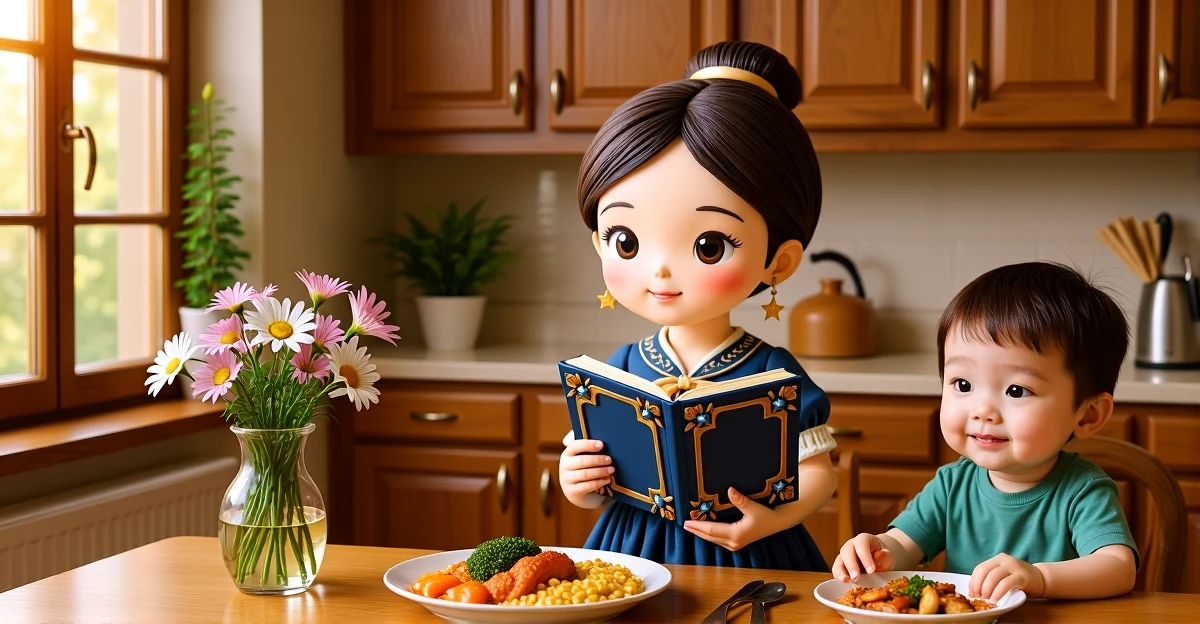

You've set the table, prepared a nutritious meal, and called everyone to dinner. But within minutes, your three or four year old is standing in their chair, kneeling on the seat, or wandering away from the table entirely. You gently remind them to sit. They sit for thirty seconds, then they're up again. By the end of the meal, you're exhausted, frustrated, and wondering what you're doing wrong.
Here's what I want you to know right away, my wonderful friend: You're not doing anything wrong. This is one of the MOST common experiences parents of preschoolers share with me. And what you're seeing isn't defiance or misbehavior. It's development in action.
In this post, we'll explore why young children struggle to sit appropriately during meals, what research tells us about this developmental phase, and most importantly, gentle strategies that actually work. Plus, I'll share a beautiful story from the Magic Book that teaches patience and cooperation in the most magical way.
Understanding What's Really Happening
When your child is three or four years old, something absolutely WONDERFUL is happening inside their growing brain. Their executive function skills are developing. Now, executive function might sound like a fancy term, but it's really just the brain's ability to manage things like impulse control, attention regulation, and yes, sitting still.
Here's the thing that changes everything: the part of the brain responsible for sitting appropriately at the table is still under construction. It's like asking a caterpillar to fly before it becomes a butterfly. The wings are coming, but they're not quite ready yet.
The Science of Sitting Still
Research from child development experts shows us that sitting still requires executive function skills that are genuinely still emerging in three and four year olds. This isn't about your child choosing not to sit. It's about their brain literally learning HOW to sit for extended periods.
According to research on executive function development in early childhood, the prefrontal cortex, which controls impulse regulation and sustained attention, develops gradually throughout the preschool years and beyond. In fact, these skills don't fully mature until well into young adulthood.
Sitting still requires executive function skills that are still emerging in 3-4 year olds.
— Northwestern College Education Masters Program
What does this mean for mealtimes? It means that when your child stands up for the fifth time during dinner, their brain isn't being defiant. It's practicing a skill that's genuinely difficult for their developmental stage.
What Your Child's Movement Is Really Telling You
The Magic Book whispers something important to me about children's movement during meals. When your child moves around, they're often communicating something their words can't yet express.
Maybe their body needs movement to help them focus. Maybe they're feeling overwhelmed by sitting for too long. Maybe they're so excited about something that their body just HAS to move. Or maybe their chair doesn't quite fit them properly, and what looks like wiggly behavior is actually a child trying to get comfortable.
Pamela Quiery, a certified parenting instructor, reminds us of something beautiful:
Children's movement during meals is often a sign of developmental needs, not defiance.
— Pamela Quiery, Certified Hand in Hand Parenting Instructor
When we understand this, everything shifts. Instead of seeing mealtime struggles as a battle to win, we can see them as opportunities to support our child's developing self-regulation skills.
The Power of Routines and Realistic Expectations
Research consistently shows that family mealtime routines provide essential structure that supports children's developing self-regulation abilities. A systematic review published in the Journal of Family Theory & Review demonstrates that consistent routines help children develop behavioral regulation and cooperation skills.
But here's what's SO important: those routines need to match your child's actual developmental capacity.
What's Realistic for Your Child's Age?
Research shows that three year olds can typically sit for about ten to fifteen minutes at a time. Four year olds might manage fifteen to twenty minutes. These aren't rigid rules, they're gentle guidelines. Your child is unique, and that's BEAUTIFUL.
If you're expecting your three year old to sit through a forty-five minute family dinner, you're setting both of you up for frustration. Not because your child is difficult, but because you're asking their brain to do something it's not quite ready for yet.
Five Gentle Strategies That Actually Work
Now that we understand what's happening developmentally, let's talk about practical strategies that support your child's learning while making mealtimes more peaceful for everyone.
1. Connection Before the Meal
Even just two minutes of your full attention before sitting down to eat makes such a difference. Look into your child's eyes. Maybe share a quick snuggle or play a silly game. This fills up their connection cup. When children feel connected to you, cooperation becomes so much easier.
2. Set Up Their Body for Success
Make sure their feet are touching the floor or resting on a footrest. Check that the chair is the right height. Sometimes what looks like wiggly behavior is actually a child trying to get comfortable in furniture that doesn't quite fit them yet. Small adjustments to their physical setup can make a surprisingly big difference.
3. Keep Mealtimes Short and Sweet
If your child can manage fifteen minutes of sitting, aim for meals that last about that long. You can always extend gradually as their skills grow. There's no prize for making mealtimes longer than your child can handle. Shorter, successful mealtimes build confidence and skills better than long, frustrating ones.
4. Create Predictable Routines
Routines are like gentle teachers for young children. When mealtimes happen at roughly the same time each day, with similar patterns, your child's brain learns what to expect. That predictability actually helps them develop the self-regulation skills they need. The routine itself becomes a scaffold that supports their growing abilities.
5. Celebrate Small Victories
Did your child sit for five minutes today when yesterday they could only manage three? That's AMAZING progress! Acknowledge their effort. Celebrate the small victories. Your child is learning one of life's important skills, and learning takes time. YEARS, actually. Your encouragement fuels their motivation to keep trying.
A Story That Can Help
In The Book of Inara, we have a beautiful story that teaches patience and cooperation in the most magical way:
The Harmony Arcade Adventure
Perfect for: Ages 4-5 (also wonderful for younger preschoolers)
What makes it special: Leo and Mia discover a magical arcade where games create beautiful light patterns, but only when the players listen carefully to each other and practice patience. At first, they want to rush through everything. But they discover that when they slow down, take turns, and cooperate, something absolutely AMAZING happens. The lights become more beautiful, the games become more fun, and they feel so proud of themselves.
Key lesson: This story teaches children, in the gentlest way, that patience and cooperation lead to wonderful outcomes. After reading this story, you can remind your child about how Leo and Mia practiced patience, just like we practice sitting together at mealtimes.
Why it works: Stories aren't just entertainment. They're gentle teachers. They show children what's possible without pressure or shame. They make learning feel like an adventure. When your child sees Leo and Mia discovering that patience creates magic, they internalize that lesson in a way that no amount of reminding at the dinner table can achieve.
When Connection Comes Before Correction
Research on gentle parenting approaches consistently shows that connection-focused strategies work better than punitive approaches. Children whose parents respond with understanding while maintaining gentle boundaries develop stronger cooperation skills over time.
What does this look like at mealtimes? It means that when your child stands up for the fifth time, you take a deep breath. You remind yourself that their brain is under construction. You gently guide them back to sitting. You acknowledge their effort, even if they only manage a few minutes. You celebrate the small victories.
And on the hard days, when it feels like nothing is working, you remember this: You're not just teaching table manners. You're building your child's capacity for self-regulation, and that's one of the greatest gifts you can give them.
You're Doing Beautifully
The Magic Book and I want you to know something important. Your child isn't trying to make mealtimes difficult. They're learning one of life's important skills, and learning takes time. The brain doesn't finish developing these executive function skills until well into young adulthood. You're in this for the long game, and that's exactly where you should be.
This phase is temporary. With your patient guidance, your child will learn. They'll develop the skills they need. And one day, you'll look back and realize that those wiggly mealtime days were just a small chapter in your beautiful story together.
Until then, be gentle with yourself. Be gentle with your child. Trust the process. And remember that every time you respond with understanding instead of frustration, you're teaching your child something far more valuable than table manners. You're teaching them that they're loved, that learning is safe, and that you're their steady guide through all of life's challenges.
With love and starlight, Inara
Related Articles
- Understanding Your Child's Growing Independence: Why Clothing Battles Are Actually Healthy Development
- Understanding Your Child's Rough Play: A Gentle Guide to Teaching Empathy
- Why Bedtime Takes Hours with Your 3-4 Year Old (And How to Make It Peaceful)
- Why Morning Routines Feel Like Battles (And the Gentle Approach That Works)
- Understanding Self-Care Resistance in Preschoolers: A Gentle Guide
Show transcript
Hello, wonderful parent! It's me, Inara, and I am so happy you're here today. You know, the Magic Book and I have been hearing from so many parents who are navigating something that feels really challenging. Mealtimes. Specifically, when your little one stands up, kneels, or moves around during meals instead of sitting appropriately at the table.
And I want you to know something right away. You are not alone in this. This is one of the MOST common experiences parents of three and four year olds share with me. And here's what's so important. What you're seeing isn't defiance or misbehavior. It's development in action.
Let me share what the Magic Book and the latest research have taught me about this beautiful, sometimes frustrating phase.
When your child is three or four years old, something absolutely WONDERFUL is happening inside their growing brain. Their executive function skills are developing. Now, executive function might sound like a fancy term, but it's really just the brain's ability to manage things like impulse control, attention, and yes, sitting still.
Here's the thing, my friend. The part of the brain responsible for sitting appropriately at the table is still under construction. It's like asking a caterpillar to fly before it becomes a butterfly. The wings are coming, but they're not quite ready yet.
Research from child development experts shows us that sitting still requires executive function skills that are genuinely still emerging in three and four year olds. This isn't about your child choosing not to sit. It's about their brain literally learning HOW to sit for extended periods.
And here's something else the Magic Book whispers to me. When your child moves around during meals, they're often communicating something important. Maybe their body needs movement to help them focus. Maybe they're feeling overwhelmed by sitting for too long. Maybe they're so excited about something that their body just HAS to move.
Pamela Quiery, a wonderful parenting expert, reminds us that children's movement during meals is often a sign of developmental needs, not defiance. And when we understand this, everything shifts.
So what can we do to support our little ones as they're learning this important skill? I'm so glad you asked!
First, let's talk about realistic expectations. Research shows that three year olds can typically sit for about ten to fifteen minutes at a time. Four year olds might manage fifteen to twenty minutes. These aren't rules, they're gentle guidelines. Your child is unique, and that's BEAUTIFUL.
Second, connection before the meal makes such a difference. Even just two minutes of your full attention, looking into your child's eyes, maybe a quick snuggle or a silly game, fills up their connection cup. When children feel connected to you, cooperation becomes so much easier.
Third, make sure their body is set up for success. Are their feet touching the floor or resting on a footrest? Is the chair the right height? Sometimes what looks like wiggly behavior is actually a child trying to get comfortable in furniture that doesn't quite fit them yet.
Fourth, keep mealtimes relatively short and sweet. If your child can manage fifteen minutes of sitting, aim for meals that last about that long. You can always extend gradually as their skills grow.
And here's something magical. Routines are like gentle teachers for young children. When mealtimes happen at roughly the same time each day, with similar patterns, your child's brain learns what to expect. That predictability actually helps them develop the self-regulation skills they need.
Now, let me tell you about a story from the Magic Book that might help. It's called The Harmony Arcade Adventure, and it's about two friends named Leo and Mia who discover something wonderful.
In this story, Leo and Mia visit a magical arcade where the games create beautiful light patterns, but only when the players listen carefully to each other and practice patience. At first, they want to rush through everything. But they discover that when they slow down, take turns, and cooperate, something absolutely AMAZING happens. The lights become more beautiful, the games become more fun, and they feel so proud of themselves.
This story teaches children, in the gentlest way, that patience and cooperation lead to wonderful outcomes. And you know what? After reading this story, you can remind your child about how Leo and Mia practiced patience, just like we practice sitting together at mealtimes.
The Magic Book shows us that stories aren't just entertainment. They're gentle teachers. They show children what's possible without pressure or shame. They make learning feel like an adventure.
Here's what I want you to remember, my wonderful friend. Your child isn't trying to make mealtimes difficult. They're learning one of life's important skills, and learning takes time. YEARS, actually. The brain doesn't finish developing these executive function skills until well into young adulthood.
So when you see your child standing at the table tomorrow, take a deep breath. Remind yourself that their brain is under construction. Gently guide them back to sitting. Acknowledge their effort, even if they only manage a few minutes. Celebrate the small victories.
And on the hard days, when it feels like nothing is working, remember this. Research shows that children whose parents respond with understanding while maintaining gentle boundaries develop stronger cooperation skills over time. You're not just teaching table manners. You're building your child's capacity for self-regulation, and that's one of the greatest gifts you can give them.
The Magic Book and I believe in you. We see how much you love your child. We see how hard you're trying. And we want you to know that you're doing beautifully.
This phase is temporary. With your patient guidance, your child will learn. They'll develop the skills they need. And one day, you'll look back and realize that those wiggly mealtime days were just a small chapter in your beautiful story together.
Until our next adventure, sweet dreams and happy mealtimes. With love and starlight, Inara.