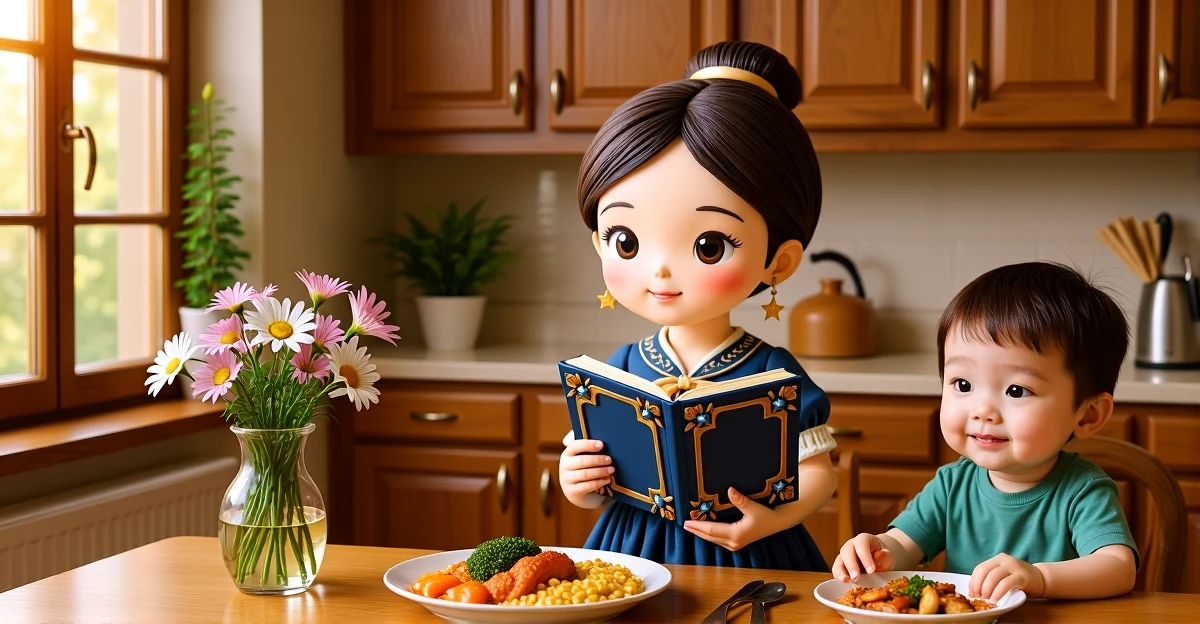

You set the table beautifully. You gave your four-year-old a fork and a napkin. You reminded them to sit nicely. And then... they grabbed their chicken with both hands, wiggled in their chair, and somehow got food on the wall three feet away.
If this sounds familiar, let me tell you something IMPORTANT: You are not alone, and your child is not behind. What you are seeing at your dinner table is not a problem to fix. It is development unfolding, exactly as it should.
In this guide, I am going to share what child development research tells us about age-appropriate table manners for four and five-year-olds, why pressuring children backfires, and what actually helps them develop these skills naturally over time. Most importantly, I am going to help you release the worry that something is wrong and embrace the beautiful truth: your child is learning, and you are doing beautifully.
What Is Really Happening at Your Table
When you watch your preschooler eat with their hands, make a mess, or refuse to sit still, it is easy to wonder if you are doing something wrong. Maybe you worry that other children their age have better manners. Maybe you feel embarrassed when they eat at someone else's house. Maybe you are just exhausted from the constant reminders that seem to go nowhere.
Here is what I want you to understand: Between the ages of two and five, children experience something remarkable. Their growth rate slows down significantly. During their first year of life, babies gain about seven kilograms and grow twenty-one centimeters. But between ages two and five, they gain only one to two kilograms per year.
This is completely normal and healthy. And here is what this means for mealtimes: when growth slows, appetite naturally decreases. Your child is not being difficult. Their body simply does not need as much food as it did when they were growing faster.
But there is more happening than just appetite changes. Your four or five-year-old is developing multiple complex skills simultaneously:
- Fine motor skills: Using a fork and knife requires intricate hand-eye coordination that takes years to master
- Impulse control: Sitting still and waiting patiently requires brain development that is still in progress
- Social awareness: Understanding why we use napkins or chew with our mouths closed requires social cognition that emerges gradually
- Attention regulation: Focusing on eating while managing conversation and family dynamics is genuinely challenging for young brains
All of this is happening at once. Your child is not refusing to use good manners. They are learning to coordinate their hands, manage their impulses, understand social expectations, and regulate their attention all at the same time. That is a LOT for a little person.
What Child Development Experts Want You to Know
The Canadian Paediatric Society offers guidance that every parent of a preschooler needs to hear: Parents should only insist on table manners that are appropriate to their child's age and developmental stage. Meals should be pleasant family times.
Let that sink in for a moment. Pleasant family times. Not training sessions. Not battles of will. Not tests of your parenting skills.
Dr. Alexander Leung and his colleagues at the Canadian Paediatric Society conducted extensive research on mealtime behavior in young children. Their findings are clear and might surprise you:
Strategies such as threats, prodding, scolding, punishment, pleading, bribing, or coercing will reduce rather than increase desired behaviors at mealtimes.
— Canadian Paediatric Society
Read that again. When we pressure children about food and manners, it actually reduces cooperation rather than increasing it. All those reminders, all that correction, all that frustration - research shows it backfires.
The American Academy of Pediatrics reinforces this message. During the preschool years, children should be eating the same foods as the family. But we need realistic expectations about how neatly they can manage this. Messy eating is not defiance. It is a child still mastering complex motor skills.
Jennifer Anderson, a registered dietitian specializing in pediatric feeding, puts it beautifully: Modeling good manners is far more effective than lecturing. Table manners develop gradually through consistent, patient guidance, not through strict enforcement.
So what does this mean for you, sitting at your dinner table with a wiggling, messy, hand-eating preschooler? It means you can take a deep breath and release the pressure. Your child is exactly where they should be.
What Is Actually Age-Appropriate for 4-5 Year Olds
Let me give you a realistic picture of what you can reasonably expect from your four or five-year-old at mealtimes. This is not about lowering your standards. This is about aligning your expectations with your child's developmental capabilities.
What You Can Expect
- Sitting at the table for 10-15 minutes - though they will wiggle, shift, and move around in their seat
- Using utensils for some foods - though they may revert to hands when tired or when food is challenging to manage
- Participating in simple family conversation - though they may interrupt, talk with food in their mouth, or lose focus
- Using a napkin with reminders - they will not remember independently every time
- Beginning to understand basic table expectations - like staying seated until excused, though they will need frequent gentle reminders
What You Should Not Expect
- Perfect, adult-like table manners
- Silent, still sitting for long meals
- Flawless utensil use for every food
- Remembering all the rules without any reminders
- Never making a mess
When you understand what is developmentally appropriate, you can celebrate the small victories instead of focusing on what is not yet mastered. Your child used their fork for three bites before switching to hands? That is progress. They sat for twelve minutes instead of ten? That is growth. They remembered to use their napkin once without being reminded? That is learning in action.
Gentle Strategies That Actually Work
So if pressuring does not work, what does? Here are research-backed strategies that support your child's natural development of table manners:
1. Model, Do Not Lecture
Your child learns far more from watching you use your fork naturally, place your napkin in your lap, and sit calmly at the table than from any lecture about proper behavior. Make mealtimes an opportunity for them to observe good manners in action, not to receive constant correction.
2. Create a Warm, Low-Pressure Atmosphere
Research consistently shows that when mealtimes are enjoyable and low-pressure, children develop better eating habits and better social skills over time. Focus on connection, conversation, and being together as a family. The manners will follow.
3. Offer Gentle Reminders Without Making Manners the Focus
A simple, calm, "Let us try using our fork" is enough. You do not need to turn every meal into a manners lesson. One or two gentle reminders per meal is plenty. The rest of the time, let your child eat, participate, and be present with the family.
4. Celebrate Small Victories
When your child does use their utensils, when they do sit for a few minutes, when they do participate in family conversation, notice it with warmth. "I noticed you used your fork for your whole piece of chicken. That was wonderful!" This positive reinforcement is far more effective than constant correction.
5. Keep Meals Short and Age-Appropriate
Expecting a four-year-old to sit through a 45-minute dinner is not realistic. Keep family meals to 15-20 minutes when young children are present. You can always have a longer adult conversation after they are excused.
6. Make Food Easy to Manage
Cut food into bite-sized pieces. Offer foods that are easier to eat with utensils. Provide child-sized forks and spoons that fit their hands. Set them up for success rather than struggle.
7. Remember That This Is Temporary
Your child will not eat with their hands forever. They will not wiggle in their chair at their high school graduation dinner. These skills develop naturally over time when children feel safe, supported, and free from pressure. Trust the process.
Stories That Can Help
In The Book of Inara, we have beautiful stories that teach children about cooperation, patience, and working together - all skills that translate beautifully to family mealtimes. Here is a story that can support your child's understanding of why we come together as a family:
The Listening Heart Center
Perfect for: Ages 4-5
What makes it special: This story teaches children that when they listen quietly and work together with others, something magical happens. Ethan and Sofia discover that cooperation and patience create the most wonderful outcomes - a lesson that applies perfectly to family mealtimes.
Key lesson: Mealtimes are not about perfect behavior. They are about being together as a family, learning to cooperate, and creating warm memories.
How to use it: After reading this story with your child, talk about how mealtimes are a time when your family works together, just like the characters in the story help their community. Remind them that everyone at the table is learning and growing, including you.
You Are Doing Beautifully
I know it can be hard when you feel like you are the only parent dealing with messy mealtimes and wiggling children. I know it can be frustrating when it feels like nothing you say makes a difference. I know it can be embarrassing when your child eats with their hands at a restaurant while other children seem so well-behaved.
But here is what I want you to remember: You are not raising a robot who performs perfectly. You are raising a human child who is learning, growing, and developing at exactly the right pace. The mess, the wiggling, the occasional hand-eating - these are all signs of a healthy, normal four or five-year-old.
Your patience and warmth during these years are teaching your child something far more important than perfect table manners. You are teaching them that they are loved exactly as they are. You are teaching them that learning takes time. You are teaching them that family meals are safe, warm places to be exactly who they are.
And those lessons? Those are the ones that will stay with them forever, long after they have mastered using a fork.
The Magic Book and I are always here, cheering you on.
With love and starlight,
Inara
Related Articles
- Understanding Physical Affection Boundaries: Why Your Child Avoids or Over-Hugs
- Why Your Child Struggles to Follow School Rules (And How to Help)
- When Your Child Plays Alone at Recess: Understanding Social Development (Ages 4-5)
- Teaching Your Child to Ask Permission: A Gentle Guide for Ages 4-5
- Helping Your 4-5 Year Old Build Friendship Skills: A Gentle Guide
Show transcript
Hello, wonderful parent. I see you. I see you watching your four or five-year-old at the dinner table, and maybe you are feeling a little worried. Maybe they are eating with their hands when you have given them a fork. Maybe they are wiggling in their chair, or making a mess, or not sitting quite the way you hoped they would. And you might be wondering if something is wrong, or if you are doing something wrong. Let me tell you something IMPORTANT. You are doing beautifully, and your child is exactly where they should be. What you are seeing is not a problem to fix. It is development unfolding, right there at your family table. Let me explain what is really happening. Between the ages of two and five, children experience something remarkable. Their growth rate slows down significantly. During their first year of life, babies gain about seven kilograms and grow twenty-one centimeters. But between ages two and five, they gain only one to two kilograms per year. This is completely normal and healthy. And here is what this means for mealtimes. When growth slows, appetite naturally decreases. Your child is not being difficult. Their body simply does not need as much food as it did when they were growing faster. The Canadian Paediatric Society tells us something crucial. Parents should only expect table manners that are appropriate to their child's age and developmental stage. Four and five-year-olds are still developing the fine motor skills needed to use utensils smoothly. They are still learning impulse control. They are still building the social awareness that helps them understand why we sit a certain way or use napkins. These skills take time to develop, and that is perfectly normal. Research shows us something else that is really important. When parents pressure children about food or manners, when we coerce or bribe or punish, it actually reduces cooperation rather than increasing it. Dr. Alexander Leung and his colleagues at the Canadian Paediatric Society found that strategies like threats, scolding, or pleading will reduce rather than increase the behaviors we hope to see. But here is what DOES work. Creating a warm, patient mealtime atmosphere. The research is clear. When parents approach meals with guidance and tolerance rather than rigid expectations, children develop better eating habits and better social skills over time. Meals should be pleasant family times, not battlegrounds. Your child is learning so many things at once right now. They are learning to feed themselves. They are learning to sit with others. They are learning to participate in family conversation. They are learning to manage their energy and attention. All of this is happening simultaneously, and it is a lot for a young brain to coordinate. The American Academy of Pediatrics reminds us that during the preschool years, children should be eating the same foods as the family. But we need realistic expectations about how neatly they can manage this. Messy eating is not defiance. It is development. Using hands sometimes is not bad behavior. It is a child still mastering complex motor skills. And you know what helps children learn these skills? Modeling. When they see you using your fork with ease, when they watch you place your napkin in your lap, when they observe you sitting calmly at the table, they are learning. Not through lectures or corrections, but through gentle observation over time. Jennifer Anderson, a registered dietitian who specializes in pediatric feeding, tells us that modeling good manners is far more effective than lecturing. Table manners develop gradually through consistent, patient guidance, not through strict enforcement. So what can you do? First, take a deep breath and release any worry that something is wrong. Your child is developing exactly as they should. Second, make mealtimes about connection, not perfection. This is a time for your family to be together, to share food and conversation and presence. Third, offer gentle reminders when needed, but do not make manners the focus of every meal. A simple, calm, "Let us try using our fork" is enough. And fourth, celebrate the small victories. When your child does use their utensils, when they do sit for a few minutes, when they do participate in family conversation, notice it with warmth. There is a beautiful story in The Book of Inara called The Listening Heart Center. In this story, Ethan and Sofia discover that when they listen quietly and work together with others, something magical happens. They learn that cooperation and patience create the most wonderful outcomes. This story reminds us that mealtimes are not about perfect behavior. They are about being together as a family, learning to cooperate, and creating warm memories. After you read this story with your child, you might talk about how mealtimes are a time when your family works together, just like the characters in the story help their community. You might remind them that everyone at the table is learning and growing, including you. Remember, wonderful parent, you are not raising a robot who performs perfectly. You are raising a human child who is learning, growing, and developing at exactly the right pace. The mess, the wiggling, the occasional hand-eating, these are all signs of a healthy, normal four or five-year-old. Your patience and warmth during these years are teaching your child something far more important than perfect table manners. You are teaching them that they are loved, that learning takes time, and that family meals are safe, warm places to be exactly who they are. The Magic Book and I are always here, cheering you on. With love and starlight, Inara.