
Hello, my wonderful friend! If you've been watching your two or three year old flit from one activity to another, unable to sit still for more than a few minutes, and wondering if something is wrong, I want you to take a deep breath. You're not alone in this worry, and I have some beautiful news to share with you.
Research shows that by age four, as many as forty percent of parents and teachers express concerns about children's attention spans. Forty percent! But here's the truth that might bring you so much relief: most of these concerns represent completely normal developmental variation. Your child isn't behind. They're not struggling. They're simply being exactly who they're meant to be at this age.
In this guide, we'll explore what research tells us about attention development in young children, why brief attention spans are not only normal but expected, and how you can gently support your child's growing focus skills. Plus, I'll share a beautiful story from The Book of Inara that teaches children about sustained attention in the most magical way.
The Beautiful Truth About Toddler Attention Spans
Let me share something that the Magic Book taught me, and that research confirms over and over again. Attention development in two to three year old children is this dynamic, rapidly evolving process. It's closely linked to emerging executive function skills, which are just beginning to blossom in your little one's brain right now.
Studies from child development experts at Kennedy Krieger Institute and Johns Hopkins University show us that selective attention at age two and a half actually predicts working memory and response inhibition abilities at age three. Isn't that WONDERFUL? This means that right now, in this very moment, your child is building the foundational skills they'll use for the rest of their life.
The Centers for Disease Control and Prevention tells us that toddlers two to three years old are developing the ability to follow simple instructions and sort objects by shape and color. They're learning to engage in pretend play, to explore their environment with curiosity, and yes, to sustain attention on activities that interest them. But here's the key: their attention span is naturally brief and highly variable.
What Influences Your Toddler's Attention
Your child's attention span is influenced by so many things:
- Developing language skills - As they learn to understand and express themselves, their cognitive resources are stretched in beautiful ways
- Cognitive development - Their brain is making millions of new connections every single day
- Individual temperament - Every child has their own unique rhythm and pace
- Physical state - Sleep, hunger, and energy levels all play a role
- Interest level - Children can focus much longer on activities they find engaging
Dr. EM Mahone and his colleagues remind us that inattention among preschoolers is not always indicative of ADHD, and may represent a variety of alternative or co-existing conditions, but most often, though, inattention is a normal variation observed in typical preschool child development. Did you hear that? Normal variation. Your child is learning, growing, and developing exactly as they should.
What This Means for Your Daily Life
So what does all this research mean for you, wonderful parent, in your everyday life with your toddler?
It means that when your two year old can't sit through an entire book, that's normal. When your three year old flits from one activity to another, that's normal. When they can focus intensely on building a block tower for five minutes but can't sit still during dinner, that's normal too. Their attention is growing, just like they are, and it needs time, patience, and the right nurturing environment.
Here's something beautiful that the Magic Book taught me. Attention grows like a plant in a greenhouse. It needs gentle care, consistent nurturing, and the right conditions to flourish. You can't force a seedling to grow faster by pulling on it, and you can't force attention skills to develop faster by demanding more than your child is ready for. But you CAN create the perfect environment for growth.
Selective attention and executive functions develop together in two to three year olds. Attention at age two and a half predicts executive function skills at age three. This developmental period is critical for building foundational attention and self-regulation skills.
— Developmental Psychology Research
Gentle Strategies to Support Your Child's Growing Focus
Now that we understand what's normal, let's talk about how you can support your child's attention development in the gentlest, most effective ways possible.
1. Give Praise When They Focus
The CDC specifically recommends this, and it's SO powerful. When you notice your little one concentrating on stacking blocks, or carefully putting puzzle pieces together, or listening to a story, acknowledge it! Say something like, "I love how you're focusing on that puzzle," or "You're working so hard on that tower!"
This positive reinforcement helps their brain understand: oh, this focusing thing is good, I want to do more of this. You're literally helping to wire their brain for sustained attention through your loving acknowledgment.
2. Encourage Free Play
Research shows that free play helps toddlers stay active and develop motor skills while building sustained attention naturally. When children choose their own activities and explore at their own pace, they're practicing attention in the most developmentally appropriate way possible.
Free play doesn't need to be complicated. It can be:
- Playing with blocks or building toys
- Exploring in the backyard or park
- Pretend play with dolls, cars, or kitchen sets
- Drawing, coloring, or painting
- Playing with water, sand, or sensory materials
The key is letting THEM lead. When children are intrinsically motivated, their attention naturally extends.
3. Create Opportunities for Pretend Play and Reading
These activities support cognitive development and naturally build attention skills. When you read together, you're not just sharing a story - you're teaching your child to sustain focus, to follow a narrative, to engage their imagination. It's all connected!
Make reading time special. Snuggle up together, use different voices for characters, pause to talk about the pictures. This isn't just about getting through the book - it's about building that beautiful capacity for sustained, engaged attention.
4. Maintain Realistic Expectations
This is SO important, my friend. Your two year old doesn't need to sit still for thirty minutes. They don't need to complete complex tasks without getting distracted. They're learning, and learning takes time.
Age-appropriate attention spans are roughly:
- Age 2: 4-6 minutes on a single task
- Age 3: 6-8 minutes on a single task
- Age 4: 8-12 minutes on a single task
These are general guidelines, and every child is different. Some days will be better than others. Some activities will hold their attention longer than others. And that's all perfectly, beautifully normal.
5. Create Simple Care Routines Together
Activities like watering a plant together, feeding a pet, or organizing toys naturally build your child's ability to sustain attention on meaningful activities. And the beautiful part? They don't feel like work or pressure. They feel like connection, like love, like growing together.
These routines teach sustained attention in the most natural way - through caring for something together, through gentle repetition, through the satisfaction of completing a meaningful task.
A Story That Teaches Attention Beautifully
In The Book of Inara, we have a story that shows this concept so beautifully, in a way that speaks directly to children's hearts.
The Greenhouse Where Plants Whisper Thank You
Perfect for: Ages 2-3
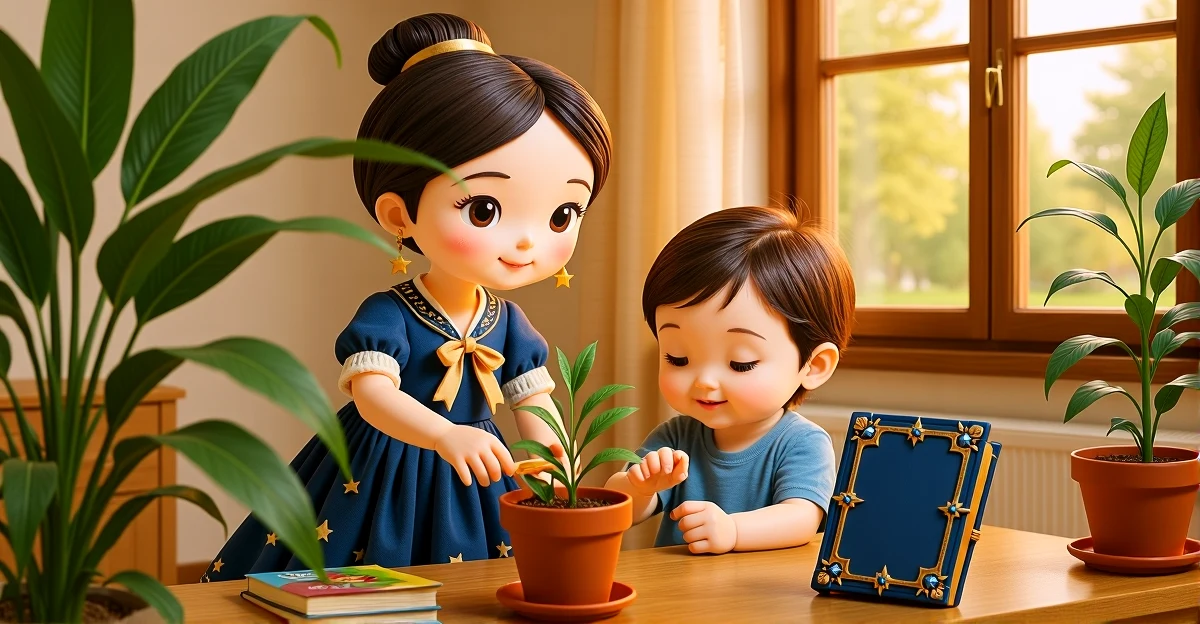
What makes it special: This story beautifully models sustained, gentle attention through caring for plants. Milo and Nana discover a magical greenhouse where plants glow softly when they're cared for with gentle touches and kind words. As they learn to focus on their green friends with patience and sustained attention, they discover that the plants grow stronger and happier.
Key lesson: Just as the plants in the greenhouse respond to gentle, consistent care, your child's attention skills blossom when they're nurtured with patience and the right environment. When Milo and Nana discover that plants glow softly when given gentle attention and kind words, children learn that focused care creates beautiful results.
How to use this story: After you share this story with your little one, you can create simple care routines together. Maybe you water a plant together each morning, or feed a pet, or organize toys. These activities naturally build your child's ability to sustain attention on meaningful activities.
You're Doing Beautifully
Here's what I want you to remember, wonderful parent. Your child's attention span is growing every single day. With your gentle support, your patient presence, and your loving guidance, they're building skills that will serve them for a lifetime.
You don't need to push. You don't need to worry. You just need to be there, creating that nurturing greenhouse environment where attention can grow naturally. When you see your child focusing on something - anything - for even a few moments, celebrate it. Acknowledge it. That's their attention muscle getting stronger.
And if your child seems to have a shorter attention span than their cousin or their friend at playgroup, that's okay. If they can focus intensely on one thing but not another, that's okay too. Every child develops at their own pace, and your child is exactly where they need to be.
The research is so clear on this. Individual differences in attention development are completely normal and expected during this age range. Your child isn't behind. They're not struggling. They're learning, growing, and developing in their own beautiful way.
The Magic Book and I believe in you. We believe in your child. And we're here to support you every step of this beautiful journey.
With love and starlight,
Inara
Related Articles
- Why Your Toddler Seems to Ignore You (And How to Help Them Listen)
- Understanding Your Energetic Toddler: Why Quiet Play Develops Gradually
- Understanding Public Meltdowns: Why Your Toddler Isn't Trying to Embarrass You
- When Your Toddler Wanders Off in Public: Understanding and Gentle Strategies
- Understanding Your Toddler's Need to Move: Why Sitting Still is Hard (Ages 2-3)
Show transcript
Hello, my wonderful friend! It's me, Inara, and I am so happy you're here today. You know, the Magic Book and I have been noticing something that many parents are wondering about. They're asking, is my child's attention span normal? Should my two or three year old be able to focus for longer? And I want you to know, if you've been wondering this too, you're not alone. In fact, this is one of the most common questions parents ask, and there's so much beautiful wisdom to share about this!
So grab a cozy cup of tea, settle in, and let's talk about your little one's growing attention span, what's completely normal for their age, and how you can gently support this wonderful developmental journey.
First, let me share something that might bring you so much relief. Research from child development experts at places like Kennedy Krieger Institute and Johns Hopkins University shows us that by age four, as many as forty percent of children have attention concerns reported by parents and teachers. Forty percent! But here's the beautiful truth, most of these concerns represent completely normal developmental variation. Your child isn't behind, they're not struggling, they're simply being exactly who they're meant to be at this age.
You see, attention development in two to three year old children is this dynamic, rapidly evolving process. It's closely linked to emerging executive function skills, which are just beginning to blossom in your little one's brain. Studies show that selective attention at age two and a half actually predicts working memory and response inhibition abilities at age three. Isn't that WONDERFUL? This means that right now, in this very moment, your child is building the foundational skills they'll use for the rest of their life.
The Centers for Disease Control and Prevention tells us that toddlers two to three years old are developing the ability to follow simple instructions and sort objects by shape and color. They're learning to engage in pretend play, to explore their environment with curiosity, and yes, to sustain attention on activities that interest them. But here's the key, their attention span is naturally brief and highly variable. It's influenced by so many things, their developing language, their cognitive skills, their individual temperament, even how much sleep they got last night!
Dr. EM Mahone and his colleagues remind us that inattention among preschoolers is not always indicative of ADHD, and may represent a variety of alternative or co-existing conditions, but most often, though, inattention is a normal variation observed in typical preschool child development. Did you hear that? Normal variation. Your child is learning, growing, and developing exactly as they should.
So what does this mean for you, wonderful parent? It means that when your two year old can't sit through an entire book, that's normal. When your three year old flits from one activity to another, that's normal. When they can focus intensely on building a block tower for five minutes but can't sit still during dinner, that's normal too. Their attention is growing, just like they are, and it needs time, patience, and the right nurturing environment.
The Magic Book taught me something beautiful about this. Attention grows like a plant in a greenhouse. It needs gentle care, consistent nurturing, and the right conditions to flourish. You can't force a seedling to grow faster by pulling on it, and you can't force attention skills to develop faster by demanding more than your child is ready for. But you CAN create the perfect environment for growth.
Here's how. First, give your child attention and praise when they do focus on something. The CDC recommends this specifically, and it's so powerful. When you notice your little one concentrating on stacking blocks, or carefully putting puzzle pieces together, or listening to a story, acknowledge it! Say something like, I love how you're focusing on that puzzle, or you're working so hard on that tower! This positive reinforcement helps their brain understand, oh, this focusing thing is good, I want to do more of this.
Second, encourage free play as much as possible. Research shows that free play helps toddlers stay active and develop motor skills while building sustained attention naturally. When children choose their own activities and explore at their own pace, they're practicing attention in the most developmentally appropriate way possible.
Third, create opportunities for pretend play, reading books together, and exploring the environment. These activities support cognitive development and naturally build attention skills. When you read together, you're not just sharing a story, you're teaching your child to sustain focus, to follow a narrative, to engage their imagination. It's all connected!
Fourth, and this is so important, maintain realistic expectations about age-appropriate attention capabilities. Your two year old doesn't need to sit still for thirty minutes. They don't need to complete complex tasks without getting distracted. They're learning, and learning takes time. The key is recognizing that building attention skills is a gradual developmental process that unfolds naturally with patient, responsive parenting support.
Now, let me tell you about a story that shows this so beautifully. In The Book of Inara, we have a story called The Greenhouse Where Plants Whisper Thank You. It's about Milo and Nana discovering a magical greenhouse where plants glow softly when they're cared for with gentle touches and kind words. As Milo and Nana learn to focus on their green friends with patience and sustained attention, they discover that the plants grow stronger and happier.
This story is such a perfect metaphor for how attention grows in your child. Just as the plants in the greenhouse respond to gentle, consistent care, your child's attention skills blossom when they're nurtured with patience and the right environment. When Milo and Nana discover that plants glow softly when given gentle attention and kind words, children watching or listening learn that focused care creates beautiful results.
After you share this story with your little one, you can create simple care routines together. Maybe you water a plant together each morning, or feed a pet, or organize toys. These activities naturally build your child's ability to sustain attention on meaningful activities. And the beautiful part? They don't feel like work or pressure. They feel like connection, like love, like growing together.
The research is so clear on this. Selective attention and executive functions, things like response inhibition and working memory, develop together in two to three year olds. Attention at age two and a half predicts executive function skills at age three. This developmental period is critical for building foundational attention and self-regulation skills. And individual differences in attention development are completely normal and expected during this age range.
So if your child seems to have a shorter attention span than their cousin or their friend at playgroup, that's okay. If they can focus intensely on one thing but not another, that's okay too. Every child develops at their own pace, and your child is exactly where they need to be.
Here's what I want you to remember, wonderful parent. Your child's attention span is growing every single day. With your gentle support, your patient presence, and your loving guidance, they're building skills that will serve them for a lifetime. You don't need to push, you don't need to worry, you just need to be there, creating that nurturing greenhouse environment where attention can grow naturally.
The Magic Book and I believe in you. We believe in your child. And we're here to support you every step of this beautiful journey. Find The Greenhouse Where Plants Whisper Thank You and other wonderful stories in The Book of Inara app. Each story is crafted with love to support your child's emotional and cognitive development in the gentlest, most magical way.
Sweet dreams and beautiful focus, my wonderful friend. With love and starlight, Inara.