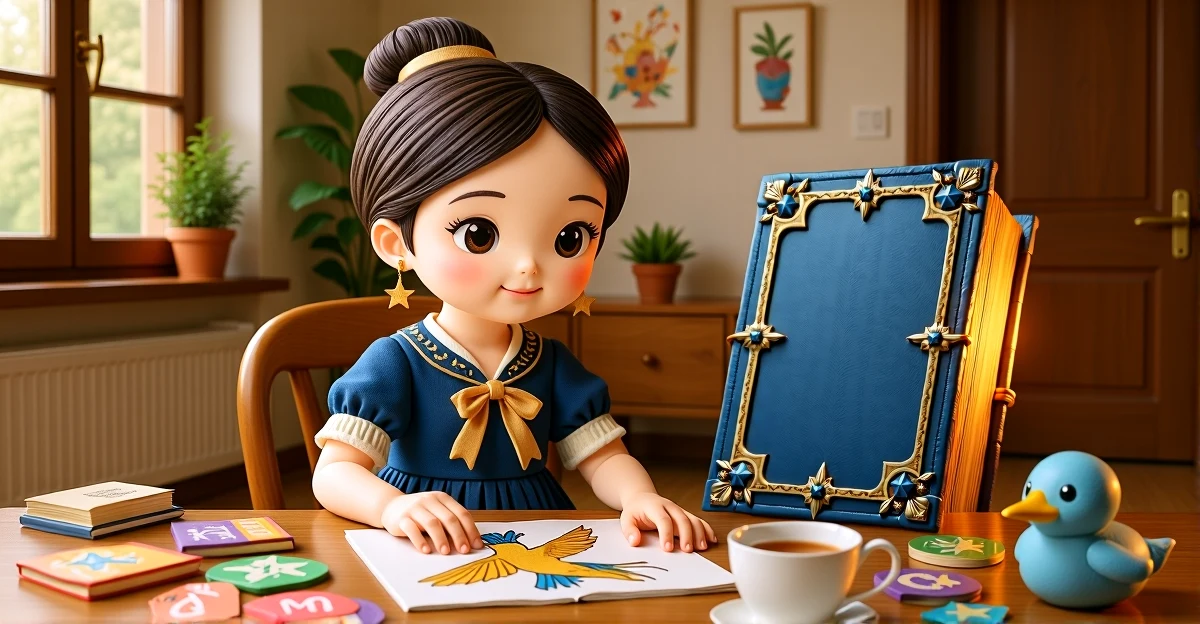

Hello, wonderful parent! It's me, Inara, and I want to talk with you about something the Magic Book and I see SO often. Your child is working on a drawing, building a tower, or practicing writing their letters. You gently suggest they could try something differently, or maybe a teacher offers some constructive feedback. And suddenly, there are tears. Frustration. Maybe even anger or a complete meltdown. And you're left wondering, why is this so hard for them?
First, I want you to know something IMPORTANT. You are not alone in this. This is one of the most common challenges parents face with five and six year olds. And there's so much beautiful wisdom we can share about what's really happening in your child's developing brain, and what you can do to help them build resilience and a genuine growth mindset.
In this post, we'll explore why feedback feels threatening to young children, what groundbreaking research teaches us about growth mindset, and gentle strategies that actually work. Plus, I'll share a beautiful story that can help your child understand that persistence and learning matter more than being perfect from the start.
Understanding Why Feedback Triggers Big Reactions
Here's what the Magic Book taught me, and what researchers have discovered. When your child has a big reaction to feedback, their brain is actually trying to protect them. You see, at this age, children are just beginning to develop their sense of self. They're figuring out who they are, what they're good at, and how they fit into the world.
And when something doesn't go perfectly, or when someone suggests they could do better, it can feel like a threat to that developing sense of self. It's not that your child is being difficult or stubborn. Their nervous system is genuinely overwhelmed.
Child development specialists have found that for many children, especially those who are highly sensitive, the inability to meet their own standards feels like a loss of control. And that triggers those intense emotional reactions we see. Claire Lerner, a child development specialist, has observed that for perfectionistic children, traditional reassurance can actually backfire.
The more I tried to tell him what a good job he was doing, the more agitated he became.
— Claire Lerner, LCSW-C, Child Development Specialist
Why does this happen? Because in their mind, they KNOW it's not perfect yet, and our reassurance feels disconnected from their reality. They need something different from us.
The Science of Growth Mindset: What Research Really Says
Now, here's where it gets really interesting. Dr. Carol Dweck's groundbreaking research on growth mindset shows us something WONDERFUL. Children benefit most when we help them focus on the process of learning, not just the outcome.
You might be thinking, but Inara, I DO praise their effort! I tell them they're doing great! And here's the beautiful nuance that Dr. Dweck emphasizes. Growth mindset is not just about praising effort. It's about teaching children to try new strategies and seek input when they're stuck.
Having children focus on the process that leads to learning like hard work or trying new strategies could foster a growth mindset and its benefits.
— Dr. Carol Dweck, PhD, Stanford University Professor of Psychology
This means that when your child is struggling, instead of just saying keep trying, we can say, let's think about this differently. What's one new way we could approach this? Who could we ask for help? What did we learn from what just happened?
This teaches them that getting stuck isn't failure. It's information. It's their brain's way of saying, time to try a different approach. And THAT is the foundation of resilience.
The research from CASEL, the Collaborative for Academic, Social, and Emotional Learning, demonstrates that when children develop these social-emotional skills, including how to respond to feedback and setbacks, they show measurable improvements in resilience and academic achievement. This isn't just about today's meltdown. This is about building lifelong skills.
Gentle Strategies That Actually Work
So what DO we do instead? The Magic Book whispers this beautiful truth: we validate their feelings first, and then we gently guide them toward seeing feedback as information that helps them grow, not as judgment of their worth.
Here are some practical strategies you can use starting today:
1. Validate the Feeling First
When your child melts down over feedback, first, take a deep breath yourself. Your calm nervous system helps regulate theirs. Then, instead of saying you're doing great, don't worry about it, try something like this:
I can see you're feeling frustrated that your letter O doesn't look exactly how you wanted. That's a normal feeling when we're learning something new.
Notice what we did there? We validated the feeling. We didn't dismiss it or try to talk them out of it. We acknowledged it as real and normal.
2. Normalize the Struggle as Part of Learning
Help your child understand that mistakes and challenges are normal parts of learning, not threats to their competence. You can say things like:
You know what? Every single person who's ever learned to write had letters that didn't look perfect at first. That's how our brains learn. We try, we notice what happened, we adjust, we try again. That's not failing, that's LEARNING.
This reframes the entire experience. Instead of seeing feedback as criticism, they can see it as part of the learning journey.
3. Focus on Process, Not Perfection
The Magic Book reminds us that children need process-focused support, not outcome-focused praise. Here's the difference:
- Instead of saying that's perfect, say I noticed you tried three different ways to solve that problem. That's exactly how learning works.
- Instead of saying you're so smart, say you worked really hard on that and tried a new strategy when the first one didn't work. I'm proud of how you kept going.
- Instead of saying good job, say I saw you ask for help when you got stuck. That takes courage and that's how we learn.
Do you see the difference? We're celebrating the learning process, the persistence, the willingness to try new things. Not just the end result.
4. Break It Down Into Manageable Steps
When your child is overwhelmed, help them focus on one small thing at a time. Let's look at what you've already figured out, and then we can try one small thing differently.
This makes the challenge feel manageable instead of overwhelming. It shows them that learning happens in small steps, not giant leaps.
5. Model Your Own Learning Process
Let your child see you struggle, try new approaches, and learn from mistakes. You know what? I tried to make this recipe three times and it didn't turn out right. So I'm going to try a different approach this time. That's how I learn!
When children see that adults also go through this process, it normalizes the experience and takes away the shame.
Stories That Can Help
And here's where stories become such powerful helpers. In The Book of Inara, we have a beautiful Peruvian folktale that brings these concepts to life in a way that speaks directly to children's hearts:
The Condor and the Hummingbird
Perfect for: Ages 6-7 (also appropriate for ages 5-6)
What makes it special: In this story, a tiny hummingbird challenges a mighty condor. Through persistence and dedication, the hummingbird shows that determination matters more than being the biggest or strongest from the start. When children hear this story, they learn something PROFOUND. They learn that it's okay not to be perfect right away. They learn that trying new approaches and not giving up is what really matters.
Key lesson: The hummingbird didn't win because it was already the best. It won because it kept going, kept learning, kept trying. This gives your child a positive framework for understanding their own learning journey.
How to use it: After you read this story together, you can remind your child, remember the hummingbird? It didn't give up when things were hard. It kept trying and learning new ways. That's exactly what you're doing right now. You're being like the hummingbird.
This gives your child a positive framework for understanding their own learning journey. Instead of seeing feedback as criticism, they can see it as part of their hummingbird journey. Part of learning and growing and getting stronger.
What This Looks Like in Real Life
Let me paint you a picture of how this might unfold. Your child is practicing writing their name. The letters are wobbly, some are backwards. You gently point out that the E is facing the wrong way. Immediately, tears start.
Here's the old approach: It's okay! You're doing great! Don't cry, it's fine!
Here's the growth mindset approach: I can see you're feeling frustrated. You wanted that E to be perfect, and it's facing a different direction. You know what? Learning which way letters face is tricky. Our brains have to practice it lots of times. Let's look at this E together and notice which way it's facing. Then we can try one more, and you can decide which way feels right. Every time you try, your brain is learning.
Notice the difference? We validated the feeling, normalized the struggle, focused on the process, and broke it down into a manageable step. We didn't dismiss their emotion or rush to fix it. We walked alongside them in their learning.
The Long-Term Gift You're Giving
And here's the beautiful truth, wonderful parent. When you help your child develop this growth mindset, when you teach them that feedback is information and mistakes are part of learning, you're giving them a gift that will serve them for their entire life.
You're teaching them that they can handle challenges. That they can learn and grow. That they are capable and resilient. That their worth isn't tied to being perfect, but to their willingness to keep learning and trying.
This doesn't mean the meltdowns will stop overnight. Learning to accept feedback is a skill, and like all skills, it takes time and practice. But with your patient, loving guidance, and with stories like The Condor and the Hummingbird to show them the way, your child will gradually build this beautiful capacity to see challenges as opportunities.
You're Doing Beautifully
So the next time your child melts down over feedback, remember this. Their reaction isn't defiance. It's their developing brain trying to protect their sense of self. Your job isn't to fix it or make it go away. Your job is to be their calm, steady presence while they learn this new skill.
To validate their feelings, normalize the struggle, and gently guide them toward seeing feedback as a helper, not a threat. To celebrate the process, not just the perfection. To show them, through your words and your presence, that learning is beautiful, mistakes are normal, and growth is always possible.
You're doing such important work, wonderful parent. The Magic Book and I see you, and we're here to support you every step of the way.
With love and starlight, Inara
Related Articles
- When Your Child Dismisses Effort: Understanding Growth Mindset in Young Children
- The Science of Growth Mindset: Why Your Child Avoids New Challenges (And How to Help Them Thrive)
- When Your Child Can't Bounce Back from Disappointments: Building Emotional Resilience (Ages 5-6)
- Why Mistakes Are Your Child's Superpower: Growth Mindset for Ages 4-5
- Understanding Personal Growth and Change: A Guide for Parents of 5-6 Year Olds
Show transcript
Hello, wonderful parent! It's me, Inara, and I am so happy you're here today. You know, the Magic Book and I have been noticing something that so many parents are experiencing right now. Your child melts down when anyone suggests they could improve something. Maybe it's a drawing that didn't turn out quite right, or a tower that fell over, or someone gently pointing out a better way to do something. And suddenly, there are tears, frustration, maybe even anger. And you're left wondering, why is this so hard for them?
First, I want you to know something IMPORTANT. You are not alone in this. This is one of the most common challenges parents face with five and six year olds, and there's so much beautiful wisdom we can share about what's really happening in your child's developing brain.
Here's what the Magic Book taught me, and what researchers like Dr. Carol Dweck at Stanford University have discovered. When your child has a big reaction to feedback, their brain is actually trying to protect them. You see, at this age, children are just beginning to develop their sense of self. They're figuring out who they are, what they're good at, and how they fit into the world. And when something doesn't go perfectly, or when someone suggests they could do better, it can feel like a threat to that developing sense of self.
Child development specialists have found that for many children, especially those who are highly sensitive, the inability to meet their own standards feels like a loss of control. And that triggers those intense emotional reactions we see. It's not that your child is being difficult or stubborn. Their nervous system is genuinely overwhelmed.
Now, here's where it gets really interesting. Dr. Dweck's research on growth mindset shows us something WONDERFUL. Children benefit most when we help them focus on the process of learning, not just the outcome. This means teaching them to try new strategies and seek help when they're stuck, not simply praising their effort alone.
You might be thinking, but Inara, I DO praise their effort! I tell them they're doing great! And here's what child development specialist Claire Lerner discovered. Sometimes, when we try to reassure perfectionistic children by telling them what a good job they're doing, it actually makes them MORE agitated. Because in their mind, they KNOW it's not perfect yet, and our reassurance feels disconnected from their reality.
So what DO we do instead? The Magic Book whispers this beautiful truth. We validate their feelings first, and then we gently guide them toward seeing feedback as information that helps them grow, not as judgment of their worth.
Let me give you some practical strategies. When your child melts down over feedback, first, take a deep breath yourself. Your calm nervous system helps regulate theirs. Then, instead of saying, you're doing great, don't worry about it, try something like this. I can see you're feeling frustrated that your letter O doesn't look exactly how you wanted. That's a normal feeling when we're learning something new. Let's look at what you've already figured out, and then we can try one small thing differently.
Notice what we did there? We validated the feeling. We normalized the struggle as part of learning. We focused on the process, not the perfection. And we broke it down into manageable steps.
The research from CASEL, the Collaborative for Academic, Social, and Emotional Learning, shows us that when children develop these social-emotional skills, including how to respond to feedback and setbacks, they show measurable improvements in resilience and academic achievement. This isn't just about today's meltdown. This is about building lifelong skills.
Here's another beautiful strategy the Magic Book taught me. Help your child understand that mistakes and challenges are normal parts of learning, not threats to their competence. You can say things like, you know what? Every single person who's ever learned to write had letters that didn't look perfect at first. That's how our brains learn. We try, we notice what happened, we adjust, we try again. That's not failing, that's LEARNING.
And here's where stories become such powerful helpers. In The Book of Inara, we have a beautiful Peruvian folktale called The Condor and the Hummingbird. In this story, a tiny hummingbird challenges a mighty condor, and through persistence and dedication, the hummingbird shows that determination matters more than being the biggest or strongest from the start.
When children hear this story, they learn something PROFOUND. They learn that it's okay not to be perfect right away. They learn that trying new approaches and not giving up is what really matters. They learn that the hummingbird didn't win because it was already the best. It won because it kept going, kept learning, kept trying.
After you read this story together, you can remind your child, remember the hummingbird? It didn't give up when things were hard. It kept trying and learning new ways. That's exactly what you're doing right now. You're being like the hummingbird.
This gives your child a positive framework for understanding their own learning journey. Instead of seeing feedback as criticism, they can see it as part of their hummingbird journey. Part of learning and growing and getting stronger.
Now, I want to share one more insight that might shift everything for you. Dr. Dweck emphasizes that growth mindset is not just about effort. It's about trying new strategies and seeking input when stuck. So when your child is struggling, instead of just saying, keep trying, you can say, let's think about this differently. What's one new way we could approach this? Who could we ask for help? What did we learn from what just happened?
This teaches them that getting stuck isn't failure. It's information. It's their brain's way of saying, time to try a different approach. And THAT is the foundation of resilience.
The Magic Book also reminds us that children need process-focused support, not outcome-focused praise. Instead of saying, that's perfect, we can say, I noticed you tried three different ways to solve that problem. That's exactly how learning works. Instead of saying, you're so smart, we can say, you worked really hard on that and tried a new strategy when the first one didn't work. I'm proud of how you kept going.
Do you see the difference? We're celebrating the learning process, the persistence, the willingness to try new things. Not just the end result.
And here's the beautiful truth, wonderful parent. When you help your child develop this growth mindset, when you teach them that feedback is information and mistakes are part of learning, you're giving them a gift that will serve them for their entire life. You're teaching them that they can handle challenges. That they can learn and grow. That they are capable and resilient.
This doesn't mean the meltdowns will stop overnight. Learning to accept feedback is a skill, and like all skills, it takes time and practice. But with your patient, loving guidance, and with stories like The Condor and the Hummingbird to show them the way, your child will gradually build this beautiful capacity to see challenges as opportunities.
So the next time your child melts down over feedback, remember this. Their reaction isn't defiance. It's their developing brain trying to protect their sense of self. Your job isn't to fix it or make it go away. Your job is to be their calm, steady presence while they learn this new skill. To validate their feelings, normalize the struggle, and gently guide them toward seeing feedback as a helper, not a threat.
You're doing such important work, wonderful parent. The Magic Book and I see you, and we're here to support you every step of the way. Find The Condor and the Hummingbird and other beautiful stories about persistence and growth in The Book of Inara app. These stories are here to help, to guide, to show your child that learning and growing is the most natural, beautiful thing in the world.
With love and starlight, Inara.